 By
ByDirect bookings put more revenue in a hotel’s pocket than OTA bookings do. A guest who books through your own website costs you roughly 4-5% in payment and booking engine fees. The same guest booking through Booking.com or Expedia costs you 15% to 25% in commission. On a A$200 room, that gap runs to about A$25 to A$45 per night, on every booking, every season.
I work with accommodation providers across Australia to build the SEO and content foundations that pull bookings back to a hotel’s own website. Here is what actually moves the needle, and what wastes budget.
Where Direct Bookings Actually Come From
1. A fast, mobile-first booking engine on your own website

2. Local and brand search visibility so guests can find and book you directly

3. Metasearch presence on Google Hotel Ads and TripAdvisor

4. Reviews and reputation that make direct booking feel safe

5. Guest retention that turns one-time OTA bookers into repeat direct bookers
Each piece supports the others. A beautiful booking engine buried on page three of Google still loses guests to the OTA listing that ranks above it.
Why OTA Dependency Costs Australian Hotels Money
OTA commissions in Australia typically run between 15% and 25% of booking revenue. Booking.com generally sits around 15%, Expedia and Agoda run higher, and effective rates climb further once a property opts into preferred-placement or advertising programs.
A guest who books direct is also more valuable long-term. You capture their email, their preferences, and their contact details at the point of booking, rather than losing that relationship to the OTA that owns the transaction.
OTAs still matter for reach. Independent Australian hotels still get a large share of first-time bookings through OTA search. The goal is not eliminating OTAs. The goal is shifting repeat guests, brand searches, and loyal customers onto your own direct channel, where the margin stays with you.
Fix Your Website and Booking Engine First
Make your booking engine fast and mobile-friendly. Most guests compare rates on a phone, often side by side with an OTA app, so a slow or clunky booking flow sends them straight back to the OTA tab.
Cut the steps between “check availability” and “confirm booking.” Every extra form field or page load drops your conversion rate, and guests who hesitate often finish the booking on an OTA instead.
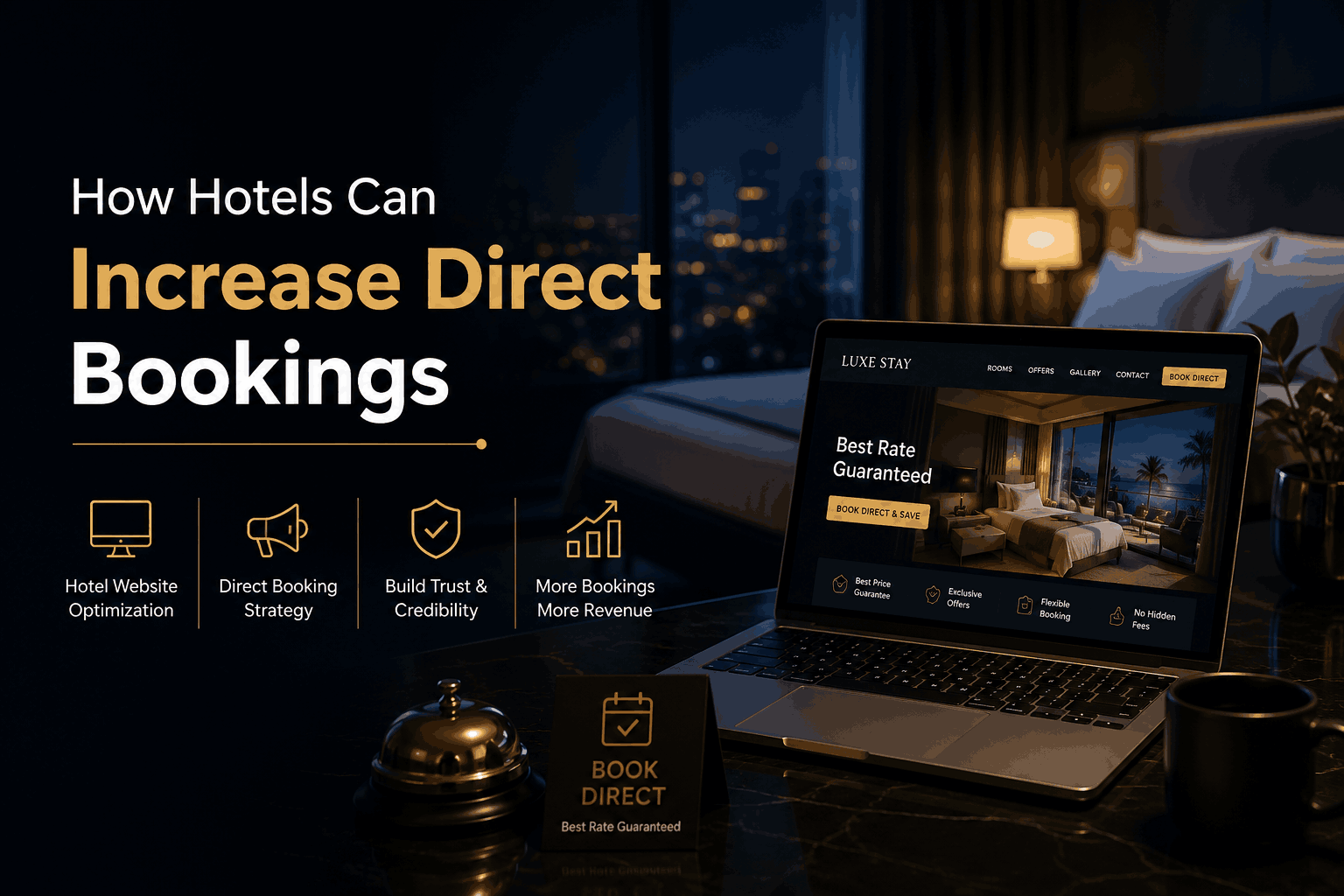
Show your best available rate clearly on your homepage. A guest who has to hunt for pricing assumes the OTA rate is the real one, even when it is not.
Add real photos and room details, not just OTA-style thumbnails. Guests trust a direct site more when it shows more detail than the OTA listing does, including room size, view, and bathroom photos.
Build a simple loyalty or member rate into the booking flow. A small, visible discount for direct bookers gives guests a reason to skip the OTA and book with you instead.
Win the SEO and Local Search Battle
Claim and optimise your Google Business Profile. This listing controls how your hotel appears in Google Search and Google Maps, including your star rating, photos, amenities, and a direct “Book” link to your own site.
Target brand searches with a clean, fast landing page. A guest searching your hotel’s name by name should land on your own website first, not an OTA listing that outranks you for your own brand.
Build location pages around real search terms. Target phrases like “hotels near Bondi Beach” or “pet-friendly accommodation Yarra Valley,” since these match how guests actually search, rather than generic terms like “luxury accommodation.”
Add hotel schema markup to your website. Structured data tells Google your room types, price range, and amenities directly, which supports rich results and stronger visibility in search.
Publish content around your region, not just your property. A guide to local attractions, events, or seasonal activities draws search traffic from guests still deciding where to stay, and gives you a page to rank before they ever check an OTA.
Use Metasearch Without Feeding the OTAs
List your direct rate on Google Hotel Ads. Metasearch tools show your own website alongside OTA listings for the same search, giving guests a direct-booking option at the exact moment they compare prices.
Do the same on TripAdvisor’s booking links. A guest reading reviews on TripAdvisor can click straight through to your own site if your listing is set up correctly, instead of defaulting to an OTA link.
Track cost per acquisition on metasearch against OTA commission. Metasearch clicks that cost less than the commission you would otherwise pay an OTA are almost always worth the spend.
Build Reviews and Trust Signals
Ask every guest for a Google review at checkout. Reviews on your Google Business Profile carry the most weight for local search and give direct bookers the same confidence an OTA review page provides.
Respond to every review, especially negative ones. A calm, specific reply shows a future guest, weighing a direct booking against an OTA one, that your hotel stands behind its service.
Feature reviews directly on your booking pages. Guests hesitate to book direct when a site shows no social proof, so pulling reviews onto your own site closes that trust gap.
Turn OTA Guests Into Repeat Direct Bookers
Capture guest email at check-in, not just at booking. A guest who arrived through an OTA can still become a direct booker next time, if you have their details and a reason to email them.
Send a pre-arrival or post-stay email with a direct booking incentive. A small discount or perk for booking direct next time converts loyal guests away from OTA fees over time.
Segment repeat guests separately from first-time bookers. A guest who has stayed with you before responds better to a direct loyalty offer than a generic promotion aimed at new audiences.
Frequently Asked Questions
How much commission do OTAs charge Australian hotels?
OTA commissions in Australia typically range from 15% to 25% of the booking value, with Booking.com generally at the lower end and Expedia or Agoda running higher, especially with preferred-placement programs.
Should a hotel drop OTAs entirely and focus only on direct bookings?
No. OTAs still bring in guests a hotel cannot reach through its own website alone. The stronger strategy shifts repeat guests and brand searches to direct booking while keeping OTAs for first-time discovery.
Does SEO actually affect hotel booking volume, or only brand awareness?
SEO affects booking volume directly. A hotel that ranks for its own brand name and for local search terms like “hotels near [landmark]” captures bookings that would otherwise go to an OTA listing ranking above it.
How long does it take to see a shift toward more direct bookings?
Website and booking engine fixes can lift conversion within weeks. SEO and local search improvements usually take three to six months to build enough ranking strength to meaningfully shift booking mix.
Can GEO help hotels get recommended by AI tools like ChatGPT?
Yes. Travellers increasingly ask AI tools for accommodation recommendations. The same structured data, reviews, and clear property information that support SEO also help a hotel get cited in AI-generated travel answers.
Get a Direct Booking Strategy Built for Your Hotel
You now have a full picture of what drives direct bookings for hotels in Australia, from your booking engine to SEO, metasearch, reviews, and guest retention.
I offer complete SEO and GEO services for accommodation providers across Australia, covering Google Business Profile optimisation, local and brand search visibility, and technical fixes that support a stronger booking engine. I also handle GEO work that improves how your hotel appears in AI-generated travel recommendations. My work includes hands-on execution, not just a list of recommendations.
Contact me today. Share your hotel’s website or booking data. I will send back a clear list of what is costing you direct bookings, and how to fix it.
Explore my SEO services or my GEO services for a fuller picture of how I work.