 By
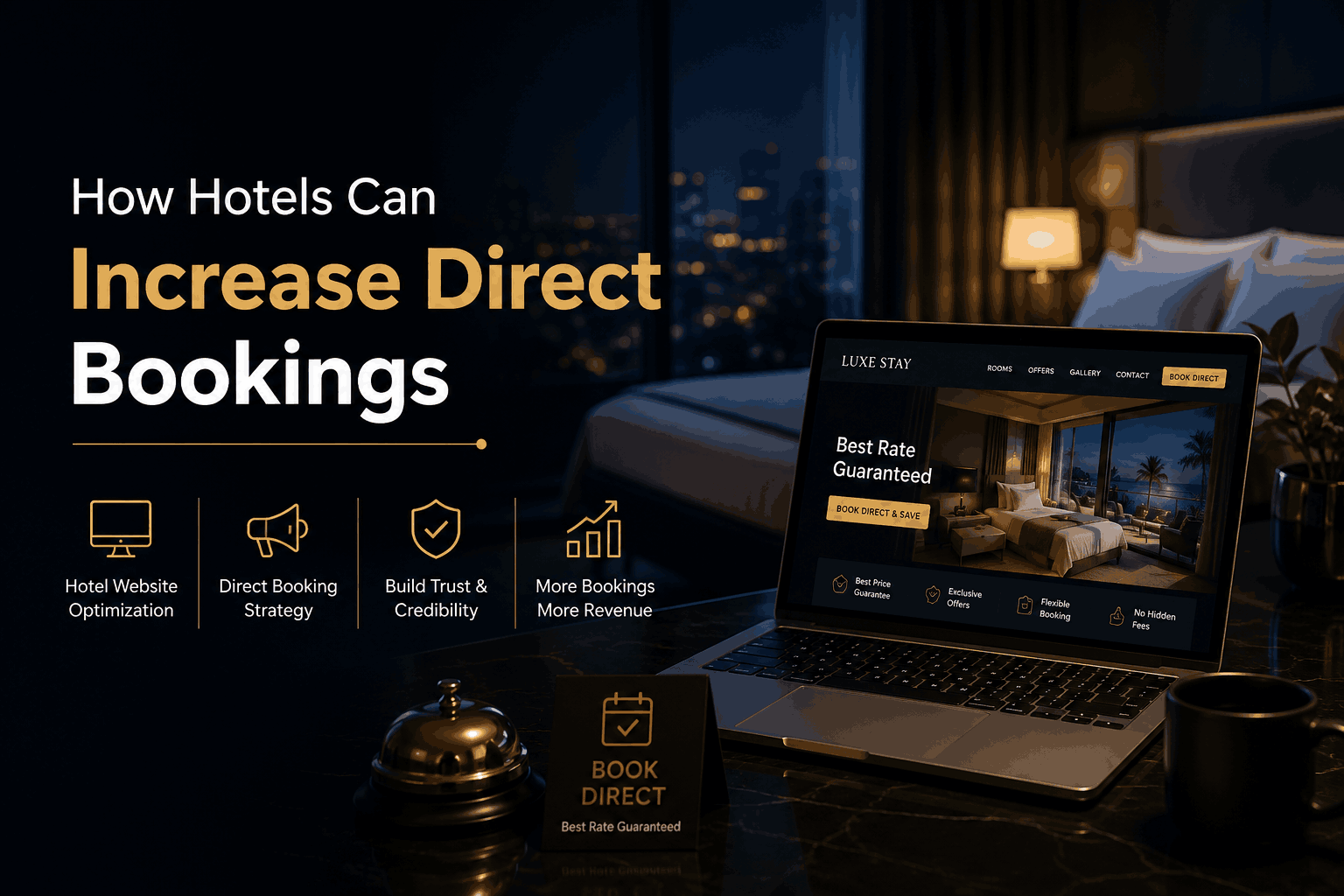
ByHotels increase direct bookings by ranking well in organic search, offering a faster and cheaper path to book than OTAs, and giving past guests a reason to book again without a middleman. Direct bookings cost less than OTA bookings, since platforms like Booking.com and Expedia charge commissions between 15% and 25% per stay. A hotel that shifts even 20% of its OTA bookings to direct channels keeps thousands of dollars in revenue it would otherwise lose to commission.
I work with hospitality and local businesses on SEO and GEO strategy. Here is the exact approach hotels use to grow direct bookings and reduce dependence on OTAs.
Core Strategies to Increase Direct Bookings
1. Rank your hotel website in Google search and AI-generated travel answers, so guests find you before they reach an OTA.

2. Match or beat OTA pricing on your own site through a best-rate guarantee.

3. Make your booking engine faster and simpler to use than any OTA checkout.

4. Build trust signals, reviews, photos, and clear policies, directly on your website.

5. Give past guests a reason to book direct again, through email, loyalty perks, or exclusive offers.
Rank Higher in Organic and AI Search
Optimize your Google Business Profile as your primary local asset. Complete every field, add current photos, and list amenities accurately, since a strong Google Business Profile often appears before OTA listings for hotel name and location searches.
Build location and experience pages beyond your homepage. Pages targeting searches like “hotels near [landmark]” or “[city] hotel with pool” capture specific search intent an OTA cannot match with a generic listing.
Write content that answers real traveler questions. Guides on parking, nearby attractions, or the best time to visit bring in organic traffic and build the kind of authority that supports higher rankings across your whole site.
Optimize for AI-generated travel answers. Tools like ChatGPT and Google Gemini now answer questions like “best hotel near [location] for families.” Clear, fact-based content on your site, amenities, room types, and nearby attractions, gives these tools accurate information to cite your property directly.
Keep your site fast and mobile-friendly. A slow site loses bookings before a guest even reaches your rates, and page speed is a confirmed ranking factor for both mobile and desktop search.
Match OTA Pricing With a Best-Rate Guarantee
Offer a public best-rate guarantee on your website. State clearly that guests will never find a lower rate on an OTA, and back this with a real policy, since guests often check OTAs first out of habit unless given a reason not to.
Remove hidden fees from your direct rate. A price that looks higher upfront but includes resort fees and taxes visible only at OTA checkout drives guests away, even when your direct rate is genuinely lower.
Monitor your OTA listings for rate parity issues. Check regularly that no OTA is undercutting your direct rate, since parity violations, intentional or not, push guests back toward third-party platforms.
Build a Booking Engine Guests Actually Want to Use
Cut the booking process down to as few steps as possible. Every extra form field or page reduces completion rate, so a two or three-step booking flow converts better than a five-step one.
Show real-time availability and pricing clearly. Guests compare your site to OTAs in real time, so any lag, confusion, or unclear pricing sends them straight back to a platform they already trust.
Make your booking engine mobile-first. Most hotel searches now start on a phone, so a booking engine that works poorly on mobile loses bookings regardless of how strong your rates are.
Add live chat or a visible phone number during checkout. A guest with a last-minute question who cannot get a quick answer often abandons the booking and finishes it on an OTA instead.
Build Trust Signals Directly on Your Site
Display real, recent guest reviews on your website, not just on OTAs. Pulling reviews from Google or TripAdvisor onto your own site keeps that trust signal working for you instead of only benefiting the platform hosting it.
Use real photos, not stock images, throughout your site. Genuine photos of actual rooms and common areas build more trust than polished stock photography, and mismatched expectations drive cancellations and bad reviews later.
State your cancellation and refund policy clearly. Uncertainty about refund terms pushes cautious guests toward OTAs, since platforms carry a reputation for handling disputes, even when your own policy is equally fair.
Give Guests a Reason to Book Direct Again
Collect email addresses at every booking and checkout. A direct email relationship lets you reach past guests without paying a platform commission on the next stay.
Offer a direct-booking-only perk. Free breakfast, a room upgrade, or late checkout available only through your own site gives guests a concrete reason to skip the OTA next time.
Run a simple loyalty program. Even a basic point system or repeat-guest discount encourages direct booking behavior over time, since guests who feel rewarded for booking direct rarely go back to paying a platform commission.
Retarget past website visitors with direct offers. A guest who checked your rates but did not book can be reminded through email or ads, pointing them back to your own booking engine instead of an OTA.
Track What Is Actually Working
Monitor the direct-to-OTA booking ratio monthly. This single number tells you whether your efforts are shifting real revenue away from commission-based platforms.
Track organic traffic and conversion rate on your booking engine. Rising traffic with a flat conversion rate points to a checkout problem, not a marketing problem.
Watch AI citation appearances for your property. Ask common questions like “best hotel in [city] near [landmark]” across ChatGPT and Gemini periodically to see whether your property gets named.
Frequently Asked Questions
How much can a hotel save by increasing direct bookings?
OTA commissions typically run 15% to 25% per booking. A hotel shifting a meaningful share of bookings to its own site keeps that commission as revenue instead of paying it to a third party.
Do direct bookings hurt a hotel’s relationship with OTAs?
No. Most hotels run both channels together. OTAs bring new guest discovery, and direct booking strategy focuses on converting repeat guests and price-sensitive searchers who would book direct if given a clear reason.
Is a best-rate guarantee legally required to match OTA rates?
No, it is a voluntary policy hotels set themselves. Many OTA contracts include rate parity clauses, so hotels need to review their specific agreements before advertising guaranteed lower direct rates.
Does SEO really help hotels compete with large OTA platforms?
Yes, for many search terms. OTAs dominate broad searches like “hotels in [city],” but specific searches, like a property name or a niche amenity, often favor a well-optimized hotel website over an OTA listing.
How long does it take to see results from a direct booking strategy?
Booking engine and pricing fixes can show impact within weeks. SEO and content improvements typically take two to four months to produce a measurable shift in organic traffic and direct bookings.
Get an SEO and GEO Strategy Built for Direct Bookings
You now know the core strategy hotels use to increase direct bookings and reduce OTA commission costs.
I offer complete SEO and GEO services, covering Google Business Profile optimization, website content, AI citation building, and technical fixes that support conversion. My work includes hands-on execution, not just a list of recommendations.
Contact me today. Share your website URL. I will send back a clear list of what is holding your direct bookings back, and how to fix it.