 By
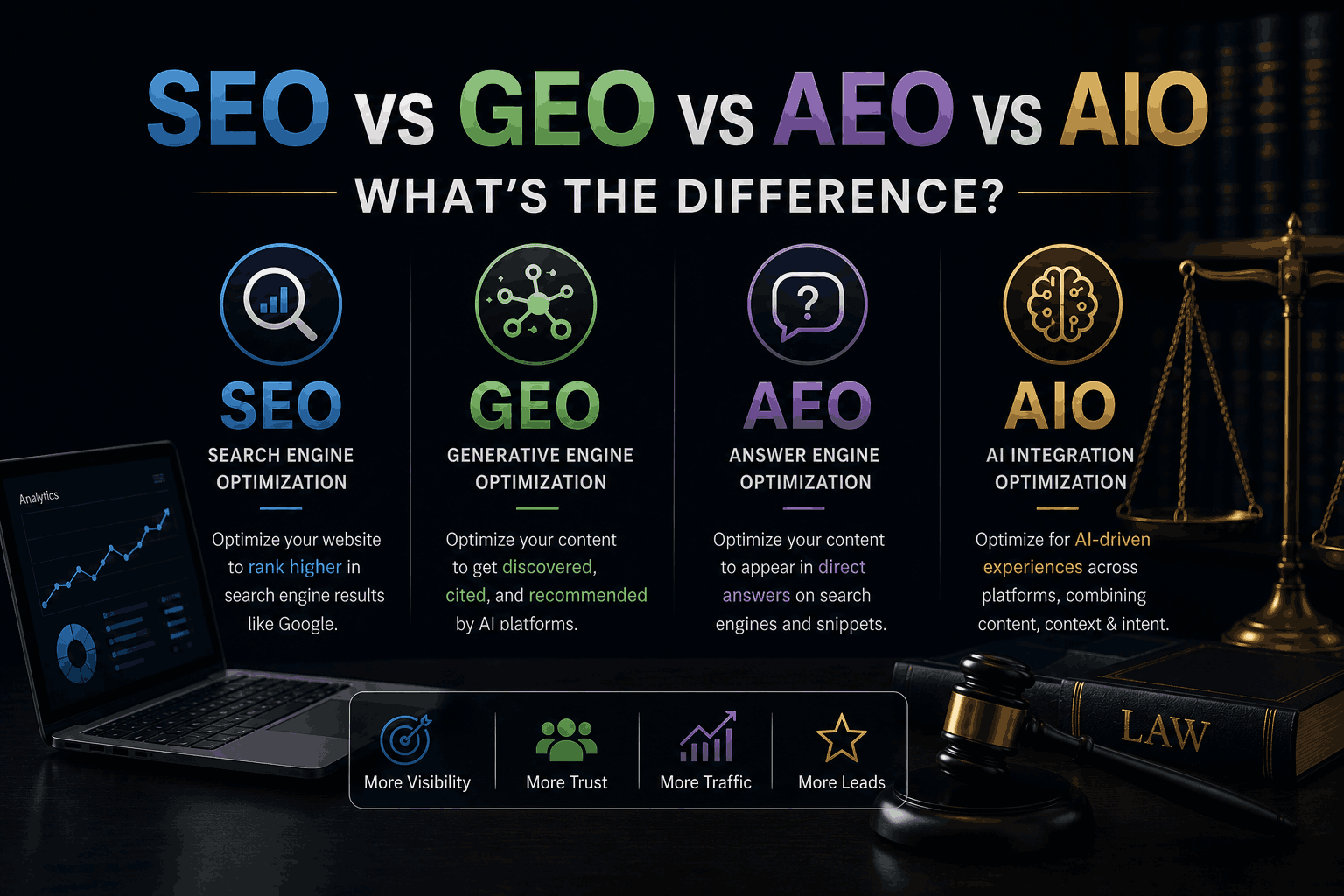
BySEO ranks your website in Google’s search results. GEO gets your brand cited inside AI-generated answers. AEO gets your content selected as the direct answer to a spoken or typed question. AIO covers how your content performs across every AI-driven surface at once, including AI Overviews, chatbots, and voice assistants. All four disciplines overlap, but each targets a different way people find information today.
I work with SEO and GEO daily across e-commerce, education, and legal clients, and I track AEO and AIO as part of the same visibility strategy.
Here I break down what each term actually means, how they differ, and how to prioritize them.
SEO vs GEO vs AEO vs AIO – Core Differences
1. SEO ranks a page in Google's list of search results. GEO gets your content cited inside a generative AI answer, on tools like ChatGPT and Gemini.

2. AEO gets your content picked as the single direct answer to a specific question, often in a featured snippet or voice response.

3. AIO covers your brand's visibility across all AI systems combined, including Google's AI Overviews, chatbots, and AI-powered search assistants.

4. SEO relies on backlinks and page authority. GEO, AEO, and AIO rely more on clear, factual, well-structured content.

5. SEO and AEO have established tracking tools. GEO and AIO are newer, and measurement methods are still developing.

6. All four disciplines reward accurate, specific, well-organized content over vague, promotional writing.
SEO vs GEO vs AEO vs AIO Comparison Table
| Factor | SEO | GEO | AEO | AIO |
|---|---|---|---|---|
| Goal | Rank your page in Google’s results list | Get your brand cited inside a generative AI answer | Get your content picked as the single direct answer | Build visibility across every AI-driven surface at once |
| Platform | Google, Bing search results | ChatGPT, Gemini, Perplexity | Featured snippets, voice assistants, “People Also Ask” | AI Overviews, chatbots, voice tools, combined |
| Main Ranking Factor | Backlinks, page authority, technical health | Content clarity and factual accuracy | Direct, concise question-and-answer structure | Structured, accurate content across all channels |
| Content Style | Long-form, comprehensive pages | Short, standalone, citation-ready paragraphs | Direct 40–60 word answers under a clear heading | Consistent facts across every content format |
| Measurement Tools | Google Search Console, rank trackers | Manual testing across AI tools | Snippet trackers, Search Console | No dedicated tool yet; manual, cross-platform testing |
| Maturity | Established for over two decades | New; best practices still developing | Established, built on SEO foundations | Newest; still forming as a category |
| Best Starting Point For | Businesses with weak search visibility | Businesses with solid SEO, ready to expand | Businesses targeting quick, factual queries | Businesses already seeing AI-driven traffic |
What SEO Does
SEO places your website on Google’s results page. A user types “best running shoes for flat feet,” and SEO determines whether your page appears on that list, and how high it ranks.
SEO depends on authority, relevance, and technical health. Backlinks, keyword-optimized pages, and a fast, error-free site combine to move your rankings up over time.
SEO results are trackable through clear metrics. Google Search Console shows exact rankings, clicks, impressions, and click-through rate by search term.
What GEO Does
GEO places your brand inside a generative AI answer. A user asks ChatGPT “what’s the best running shoe brand for flat feet,” and GEO determines whether your brand gets named in that response.
GEO depends on content AI models can extract with confidence. A short, standalone paragraph that answers one question clearly gets cited far more often than a long, promotional page.
GEO depends on consistency across the web. Your brand name, offerings, and facts need to match across your site, directories, and review platforms, since AI models cross-check sources before they cite one.
GEO results are harder to measure directly. No standard tool like Search Console exists for AI citations yet, so tracking relies on manually testing real questions across AI tools.
What AEO Does
AEO gets your content selected as the direct answer. When someone asks Google or a voice assistant “how many calories are in an apple,” AEO determines whether your page supplies that exact answer, often shown as a featured snippet or read aloud by a voice device.
AEO depends on question-and-answer content structure. A clear question as a heading, followed immediately by a direct, concise answer, performs far better than an answer buried inside a long paragraph.
AEO overlaps closely with traditional SEO. Featured snippets, “People Also Ask” boxes, and voice search results all pull from pages that already rank well in Google, so strong SEO usually supports strong AEO.
AEO rewards precision over length. A 40-to-60-word direct answer, placed right after the question, gets selected more often than a page that makes the reader search for the answer.
What AIO Does
AIO covers your visibility across every AI-driven search surface at once. This includes Google’s AI Overviews, ChatGPT, Gemini, Perplexity, and voice assistants, treated as one combined visibility goal rather than separate channels.
AIO pulls together the practices behind SEO, GEO, and AEO. Structured content, factual accuracy, schema markup, and consistent brand information support visibility across all of these systems together, not just one.
AIO is the newest and broadest of the four terms. Standards are still forming, and no single platform reports AIO performance directly, so it functions more as a strategy umbrella than a separate technical discipline.
AIO matters most for brands with meaningful AI-driven traffic already. A business that sees regular referral traffic or citations from AI Overviews and chatbots benefits from treating AIO as its own tracked initiative.
Where These Four Overlap
All four depend on genuinely useful, well-structured content. A page that answers a real question with specific facts performs well across Google rankings, featured snippets, and AI-generated answers at the same time.
All four depend on trust signals. Consistent business information, clear credentials, and real reviews build confidence with search engines, AI models, and readers together.
All four use structured data. Schema markup helps Google generate rich results, helps voice assistants pull direct answers, and helps AI models confirm facts quickly.
All four start with the same research step. Understanding the exact questions your audience asks, whether typed into Google, spoken to a voice assistant, or asked to ChatGPT, drives the content strategy behind all four disciplines.
Where These Four Diverge
SEO targets a results page. AEO targets a single answer. GEO targets a generated response. AIO targets every AI surface at once. Each discipline competes for a different spot: a ranking position, a snippet slot, a citation inside AI text, or general presence across the entire AI search landscape.
SEO and AEO have mature tracking. GEO and AIO do not, yet. Rank trackers and snippet-tracking tools are standard. GEO and AIO rely mostly on manual testing across AI platforms, since dedicated reporting tools are still early.
SEO rewards comprehensive pages. AEO and GEO reward short, direct answers. A long service page can rank well in Google, but the specific answer an AI tool or voice assistant extracts still needs to work as a short, standalone paragraph.
AIO sits above the other three rather than beside them. SEO, GEO, and AEO each target one specific mechanism. AIO measures the combined result of all three working together across the full AI search environment.
How to Prioritize SEO, GEO, AEO, and AIO for Your Business
Start with SEO if your website has weak search visibility today. Google still drives more direct traffic than any AI tool for most businesses, so foundational SEO delivers the fastest, most measurable results first.
Add AEO once your core pages rank reasonably well. Restructuring existing content into clear question-and-answer formats is a fast, low-cost way to capture featured snippets and voice answers.
Add GEO as AI-driven research grows among your customers. GEO builds on the same clear, factual content that strong SEO and AEO already require, so the three efforts reinforce each other.
Treat AIO as your long-term tracking layer, not a separate project. Once SEO, GEO, and AEO are in place, monitor your combined visibility across AI Overviews, chatbots, and voice tools as one ongoing metric.
Frequently Asked Questions
Is AEO part of SEO, or separate from it?
AEO overlaps closely with SEO and often falls under the same technical work, like schema markup and page structure. Many consultants treat it as a specialized branch of SEO rather than a fully separate discipline.
Do I need to hire separate consultants for each of these?
Not necessarily. One consultant experienced across SEO, GEO, and AEO can usually build a single strategy that supports all three, since the core skills and content standards overlap heavily.
Which one should a small business focus on first?
SEO, in almost every case. It has the largest existing traffic potential and the most mature tools for tracking return on investment.
Is AIO the same thing as GEO?
No. GEO focuses specifically on getting cited inside generative AI answers. AIO is a broader term covering visibility across all AI search surfaces, including GEO, AEO, and AI Overviews together.
How do I track whether my content shows up in AI Overviews or chatbot answers?
Ask your target customer questions directly across Google, ChatGPT, Gemini, and Perplexity, and check whether your brand appears in the response. Repeat this regularly, since AI-generated answers change over time.
Get a Combined SEO, GEO, and AEO Strategy for Your Business
You now know exactly how SEO, GEO, AEO, and AIO differ, where they overlap, and how to prioritize them.
I offer complete SEO and GEO services, covering technical fixes, content strategy, question-and-answer optimization, schema markup, and AI citation building. My work includes hands-on execution, not just a list of recommendations.
Contact me today. Share your website URL. I will send back a clear list of what is holding your visibility back, across Google, AI Overviews, and AI search tools, and how to fix it.