 By
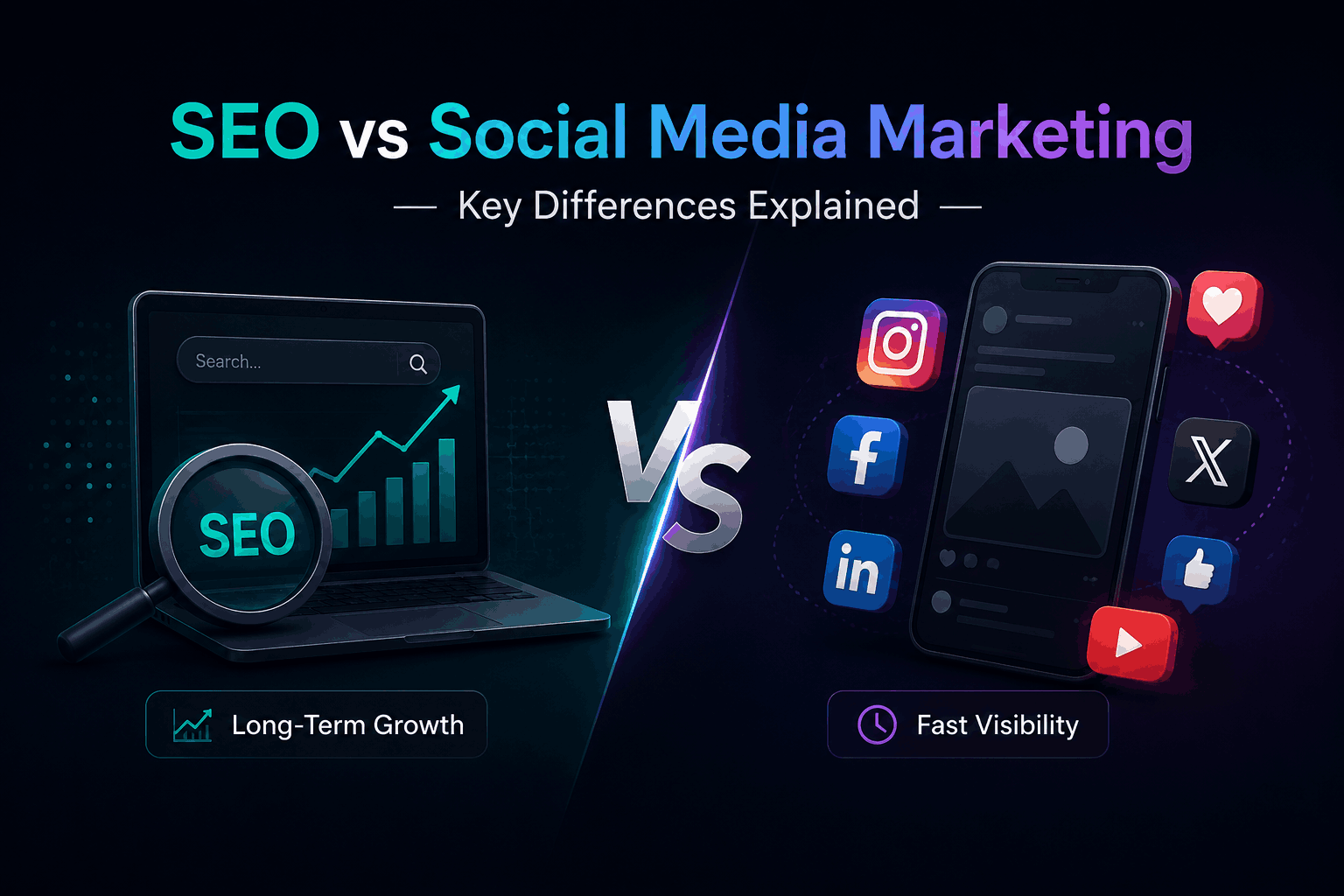
BySEO gets your website found when someone searches on Google. Social media marketing gets your brand seen while someone scrolls a feed. SEO targets people actively looking for a solution. Social media marketing reaches people who are not looking for anything yet. Both channels build visibility, but they work through different user intent, different timelines, and different content formats.
I work with e-commerce brands, law firms, and educational institutions on both channels. Here I explain exactly how SEO and social media marketing differ, where they support each other, and how to decide where to invest first.
SEO vs Social Media Marketing – Core Differences
1. SEO captures demand. Social media marketing creates demand.

2. SEO results compound over months and stay live once a page ranks. Social media results peak fast and fade within days.

3. SEO content lives on your own website, under your control. Social media content lives on a platform you do not own.

4. SEO success depends on search intent, keyword targeting, and technical site health. Social media success depends on content format, timing, and platform-specific engagement patterns.

5. SEO traffic tends to convert at a higher rate, since the visitor already searched for your exact solution.
What SEO Delivers
SEO puts your business in front of people who already want your solution. A person searching “family lawyer near me” or “best running shoes for flat feet” has clear intent, and a well-optimized page meets that intent directly.
SEO builds a durable traffic asset. A page that ranks well can keep bringing visitors for years with minimal ongoing work, unlike a social post that stops performing within a day or two.
SEO requires patience before it pays off. New content typically takes three to six months to gain meaningful rankings, so SEO rewards businesses that plan for the medium term, not the next week.
SEO gives you full ownership of the traffic channel. Your website, your content, and your rankings belong to you. No platform can change an algorithm overnight and remove your audience access, the way a social platform can.
What Social Media Marketing Delivers
Social media marketing puts your brand in front of people before they start searching. A well-placed post can introduce your product to someone who did not know they needed it, building awareness that later turns into a direct search for your brand.
Social media marketing moves fast. A single post can go live and reach thousands of people within hours, giving you speed that SEO cannot match.
Social media marketing builds direct relationships with your audience. Comments, shares, and replies create two-way interaction that a search results page cannot offer.
Social media marketing depends on consistent, frequent output. Platforms reward accounts that post regularly, so results require ongoing content production, not a one-time setup.
Where SEO and Social Media Marketing Overlap
Both channels depend on genuinely useful content. A blog post that answers a real question can rank in Google and get shared on social media at the same time, since useful content performs well everywhere.
Both channels build brand trust over time. A business that shows up consistently in search results and in social feeds looks more established than one that only shows up in one place.
Both channels benefit from each other’s signals. Social shares can drive early traffic to a new page, helping it get indexed and noticed faster, while strong SEO content gives your social accounts something valuable to share.
Both channels need clear audience research. Understanding what your audience searches for, and what they engage with on social platforms, uses similar research methods, even though the platforms differ.
Where SEO and Social Media Marketing Diverge
SEO targets a search box. Social media targets a feed. A search box shows intent already formed. A feed shows content to people who were not looking for it, so the content itself needs to earn attention immediately.
SEO rewards depth. Social media rewards brevity. A detailed, 2,000-word guide can rank well in Google. That same depth rarely performs on a platform built for short posts and quick scrolling.
SEO has slow, compounding payoff. Social media has fast, temporary payoff. A ranking page keeps working for years. A viral post drives a spike in traffic that typically fades within a week.
SEO relies on one search engine’s algorithm. Social media relies on several different platform algorithms. Google’s ranking factors stay relatively stable. Instagram, TikTok, and LinkedIn each reward different content formats and change their algorithms often.
Do You Need SEO or Social Media Marketing?
Start with SEO if your business depends on people actively searching for your product or service. Law firms, medical practices, and e-commerce stores with clear product searches usually see faster return from SEO investment first.
Start with social media marketing if your product needs explanation or discovery before someone searches for it. New or unfamiliar products often need social content to build awareness before search demand exists at all.
Run both together once your budget allows it. SEO and social media marketing reinforce each other, so a combined strategy typically outperforms either channel alone over a full year.
Match your channel choice to your sales cycle. A business with a short sales cycle benefits from social media’s speed. A business with a longer, research-driven sales cycle benefits more from SEO’s ability to capture people already comparing options.
How to Choose the Right Approach for Your Business
Look at where your customers already search or scroll. A B2B software company’s buyers likely search Google and read LinkedIn. A fashion brand’s buyers likely discover products on Instagram or TikTok first.
Check your current traffic sources before committing budget. Review your analytics to see whether search or social already sends meaningful traffic, and build on the channel showing early signs of traction.
Set separate, realistic timelines for each channel. Judge SEO results over a quarter or longer. Judge social media results within weeks, since the feedback loop moves much faster.
Assign clear ownership for content production. SEO needs consistent publishing and technical maintenance. Social media needs frequent, platform-specific content. Trying to run both without dedicated effort on each usually produces weak results in both.
Frequently Asked Questions
Is SEO more important than social media marketing?
Neither is universally more important. SEO usually delivers a stronger return for businesses with clear search demand, while social media delivers a stronger return for businesses that need to build awareness first.
Can social media marketing improve my SEO rankings directly?
Social shares are not a direct Google ranking factor, but they can drive early traffic and links to new content, which indirectly supports its ability to rank.
How long does SEO take compared to social media marketing?
SEO typically takes three to six months to show meaningful results. Social media marketing can show engagement within hours, though sustained business impact still takes consistent effort over months.
Should a small business invest in both channels at once?
A small business with limited budget often gets a better return by focusing on one channel first, based on where its customers already search or scroll, then adding the second channel once the first is working.
Which channel converts better, SEO or social media?
SEO traffic generally converts at a higher rate, since visitors arrive with existing intent. Social media traffic often requires more steps, and more content touchpoints, before it converts.
Get an SEO and Social Media Strategy Built for Results
You now know exactly how SEO and social media marketing differ, where they support each other, and which one your business should prioritize first.
I offer complete SEO services, covering technical fixes, content strategy, and search visibility across Google and AI search tools. If social media supports your growth plan, I can also help you decide how it fits alongside your SEO investment.
Contact me today. Share your website URL. I will send back a clear list of what is holding your visibility back, and how to fix it.