 By
ByOptimize your practice area content, site structure, schema markup, and off-site presence, in that order. AI search tools like ChatGPT, Google Gemini, Perplexity AI, and Bing Copilot now answer legal questions directly, often before a user ever visits a law firm’s website. A firm invisible to these tools loses a growing share of early-stage client research.
I am Prabir Mandal, an SEO and GEO specialist. I have worked with law firms on technical SEO, redirect mapping, and content built specifically for AI citation. Lets understand every step of optimising a law firm website for AI search, in full technical detail.
A Law Firm AI Search Optimisation Checklist

1. Practice area pages give direct, specific answers near the top.

2. Site structure separates each practice area onto its own dedicated page.

3. Schema markup confirms your firm, services, and locations clearly.

4. Content answers real client questions, not generic marketing claims.

5. Firm details stay consistent across your website and every external listing.

6. Reviews, credentials, and case results are visible and current.

7. Other trusted sources reference and link to your firm.
Understand How AI Search Tools Select a Source
AI tools favor content they can extract with confidence. A page that states a fact plainly, in a short, direct sentence, is far easier to cite than a page wrapped in vague marketing language. Write your key facts as standalone statements an AI tool can lift directly.
These tools cross-check information across multiple sources. A fact that appears consistently across your website, directories, and review platforms carries more weight than a fact found in only one place.
Recency matters, especially for legal information. Laws, fees, and processes change. AI tools favor sources that show clear signs of being current, such as recent reviews, updated content dates, and accurate contact details.
Restructure Your Practice Area Pages
Give each practice area its own dedicated page. A single page covering five services gives an AI tool no clear match for a specific question. Separate pages let each one target its exact topic in full depth.
Open each page with a direct answer to the main question. A visitor or an AI tool asking “what does an immigration lawyer do” should find a clear, two or three sentence answer at the very top of the page, before any other content.
Cover process, cost, and timeline explicitly. These three details answer the questions people most often ask an AI tool before contacting a firm directly. Vague pages that avoid mentioning cost or timeline get skipped in favor of firms that answer clearly.
Write one standalone paragraph summarizing each core service. This paragraph should fully explain the service without needing the rest of the page for context, since AI tools often extract a single passage rather than an entire page.
Add Schema Markup That Confirms Your Details
Implement LegalService schema on your website. This structured data confirms your firm name, practice areas, address, and contact details in a format AI tools and search engines read directly.
Add Attorney schema for individual lawyer profiles, including credentials, bar admissions, and specific practice focus, so each attorney’s expertise is clearly machine-readable.
Use FAQ schema on practice area pages. Structuring common client questions as FAQ schema matches how AI tools extract question-and-answer content, increasing the chance your exact answer gets surfaced.
Confirm your schema with Google’s Rich Results Test. Misconfigured schema is common, particularly after a theme or template change, and broken schema provides no benefit at all.
Build Real Credibility Into the Page
Show specific, verifiable results, where professional rules allow. A stated figure such as “handled over 300 immigration cases since 2015” gives both readers and AI tools a concrete fact to trust and cite.
Keep client reviews visible and current on the page itself. A steady stream of recent reviews signals an active, trustworthy practice, and AI tools increasingly reference review volume and recency as a trust signal.
List attorney qualifications clearly on every profile. Bar admissions, years of practice, and specific case experience all support the kind of verifiable detail AI tools use to judge a source.
Keep Your Information Consistent Everywhere
Match your name, address, and phone number across every platform, including your website, Google Business Profile, legal directories, and social profiles. Inconsistent details reduce an AI tool’s confidence in citing your firm at all.
Update every directory listing when your practice areas or details change. An outdated directory entry still active online can quietly contradict your current website, weakening trust signals across your entire online presence.
Audit your online listings at least twice a year. Old addresses, disconnected numbers, or former partners still listed as active are common, and each one chips away at consistency.
Earn Citations From Other Trusted Sources
Get listed on established legal directories relevant to your practice area and location. These listings function as independent confirmation of your firm’s existence and specialty, strengthening how confidently AI tools cite you elsewhere.
Seek mentions in legal publications, local news, or industry roundups. A citation from an established, independent source carries more weight than content published only on your own site.
Build links from credible legal and local business sources, since these references act as verification points that both traditional search engines and AI tools use to confirm your standing.
Monitor Your AI Search Visibility
Ask AI tools directly about your practice area and location. Search ChatGPT, Google Gemini, and Perplexity AI with the exact questions your clients would ask, and check whether your firm appears in the answer.
Track which competitors get mentioned instead of you. If a competitor consistently appears where you do not, review their practice area pages and directory presence for gaps in your own.
Recheck your visibility every few months. AI search results shift as tools update their models and as your content, schema, and citations improve over time.
Frequently Asked Questions
Is AI search optimisation different from traditional SEO for law firms?
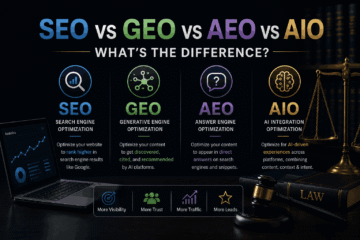
Yes, though they overlap. Traditional SEO focuses on ranking in Google’s search results. AI search optimisation, or GEO, focuses on getting your content extracted and cited directly inside an AI-generated answer, which requires more direct, quotable content structure.
Do I need separate content for AI search and for Google?
No. Well-structured, direct, specific content supports both traditional Google rankings and AI citation. The same practice area page, written clearly, serves both purposes.
How long does AI search optimisation take to show results?
Structural changes like schema and consistency fixes can show impact within weeks. Building broader citation presence through directories and mentions typically takes a few months.
Can a small law firm compete with larger firms in AI search results?
Yes. AI tools cite clear, specific, well-structured content over vague or outdated content, regardless of firm size. A smaller firm with a precise, well-built website often outperforms a larger firm with a generic one.
Should I pay for directory listings to improve AI search visibility?
Free listings on reputable, relevant directories often provide the most value. Paid listings can help on directories with strong domain authority and real traffic, but the listing’s relevance and accuracy matter more than the price paid for it.
Get Your Law Firm Website Optimized for AI Search
You now know exactly how to structure, mark up, and build credibility into a law firm website so AI tools can find, verify, and recommend it.
I run full GEO and SEO audits for law firms, covering content restructuring, schema implementation, and citation building. My work includes hands-on fixes, not just a list of recommendations.
Contact me today. Share your website URL. I will send back a clear list of what is holding your AI search visibility back, and how to fix it.