 By
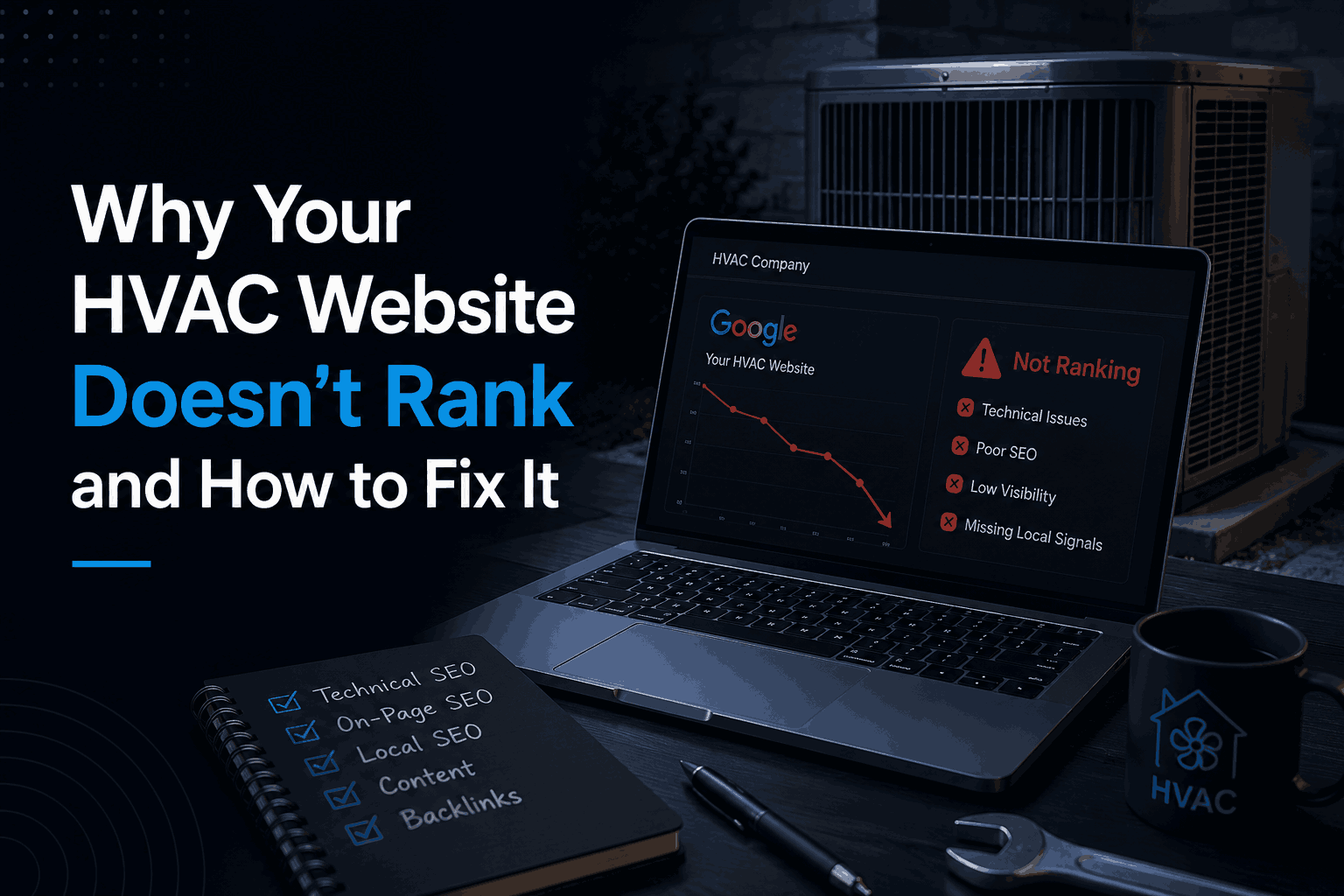
ByMost HVAC websites fail to rank because of thin service pages, missing local signals, slow load speed, weak backlink profiles, and inconsistent business information across the web. Each problem is fixable, and most HVAC companies see ranking movement within a few months once the core issues are corrected.
I have worked with home service businesses to diagnose and fix exactly these ranking problems. Here I break down the most common reasons an HVAC website fails to rank, and the direct fix for each one.
Here Is Why Your HVAC Website Doesn’t Rank
1. Thin or duplicate service pages with no real detail.

2. A weak or incomplete Google Business Profile.

3. Missing or inconsistent local business information (NAP).

4. Slow page speed and poor mobile experience.

5. Few or low-quality backlinks.

6. No content targeting real customer questions.

7. Missing or incorrect schema markup.

8. No clear conversion path for visitors.
1. Thin or Duplicate Service Pages
A single page covering every service ranks for none of them well. Google needs a dedicated page for each core service, like AC repair, furnace installation, or duct cleaning, to understand what you actually offer and match it to specific searches.
Copied or template content signals low quality. Many HVAC websites use near-identical text across service and location pages, which gives Google little reason to rank one page over a competitor’s page with the same content.
The fix: write one detailed page per service. Cover what the service includes, typical cost range, how long it takes, and common signs a homeowner needs it. Add real photos and a clear call-to-action on every page.
2. Weak Google Business Profile
An incomplete profile ranks lower in local map results. Missing categories, outdated hours, or a lack of photos all reduce how relevant and trustworthy your profile looks to Google.
Low or inconsistent review activity hurts local ranking. A profile with old reviews and no recent activity signals a business that may no longer be reliable, even if that’s not true.
The fix: complete every section and keep it active. Add all relevant service categories, upload real job photos regularly, post updates through Google Posts, and request reviews consistently after each job.
3. Inconsistent Business Information (NAP)
Mismatched name, address, or phone number across the web confuses Google. If your website lists one phone number and a directory listing shows another, Google struggles to confirm which listing is accurate, which weakens local ranking trust.
Old directory listings often carry outdated information. A business that moved locations or changed phone numbers years ago often still has old listings live, actively working against current rankings.
The fix: audit and correct every listing. Check your website, Google Business Profile, Facebook, Yelp, and major directories. Update every instance to match exactly, down to formatting and abbreviations.
4. Slow Page Speed and Poor Mobile Experience
A slow website loses both rankings and visitors before they see your content. Most HVAC searches happen on mobile, often during an emergency, so a page that takes more than a few seconds to load loses the visitor to a faster competitor.
Large, unoptimized images are the most common cause. HVAC websites often carry oversized photos of trucks and job sites that were never compressed for web use, which drags load time down significantly.
The fix: compress images and simplify page code. Convert images to modern formats, remove unused plugins and scripts, and test speed regularly using Google’s PageSpeed Insights tool.
5. Few or Low-Quality Backlinks
Backlinks remain a strong local ranking factor. A website with few links from relevant, trustworthy sources struggles to compete against established competitors with stronger link profiles, even with better on-page content.
Generic directory submissions alone don’t move the needle. Many HVAC companies rely only on basic directory listings, which carry little ranking value compared to links from local news sites, industry associations, or partner businesses.
The fix: build links through real local relationships. Sponsor a local event, partner with a related local business for a cross-link, or get featured in local news coverage. Each of these earns a link that carries genuine authority.
6. No Content for Real Customer Questions
A website with no supporting content misses a large share of search traffic. Homeowners search questions like “why is my AC leaking water” or “how often should I replace my furnace filter” long before they search for a specific company.
This content also builds trust before the first call. A homeowner who finds a clear, helpful answer to their problem on your site is far more likely to call you when they need a technician.
The fix: publish a steady stream of helpful, specific content. Answer real questions your customers ask, using clear, direct language, and link that content back to your relevant service pages.
7. Missing or Incorrect Schema Markup
Schema helps Google understand and display your business correctly. Without LocalBusiness, Service, and Review schema, Google has to guess at key details, which can result in missed rich results and lower click-through rates.
Incorrect schema can actively hurt a listing. Outdated or mismatched schema, like an old address or wrong service list, can create the same trust problem as inconsistent NAP data across the web.
The fix: add and validate structured data on every key page. Implement LocalBusiness schema site-wide, Service schema on each service page, and Review schema where genuine reviews appear. Test every page using Google’s Rich Results Test tool.
8. No Clear Conversion Path
A website can rank well and still fail to generate leads. If the phone number is hard to find, the contact form is buried, or there’s no clear call-to-action, ranking traffic goes to waste.
Too many competing actions confuse visitors. A page offering five different buttons, chat, form, email, phone, and a newsletter signup, gives the visitor too many choices and often results in no action at all.
The fix: make one action obvious on every page. Place a clickable phone number and a short contact form above the fold, and keep the rest of the page focused on supporting that one primary action.
Frequently Asked Questions
How long does it take to fix HVAC SEO problems and see ranking improvement?
Technical fixes, like schema and NAP corrections, can show impact within a few weeks. Content and backlink improvements typically take three to six months to produce noticeable ranking movement.
Is Google Business Profile more important than the website for local ranking?
Both matter together. The Google Business Profile drives map pack visibility directly, while the website supports rankings for broader search terms and builds trust once a visitor clicks through.
Can a new HVAC website compete with older, established competitors?
Yes, though it takes longer. A new site needs stronger, more specific content and a faster link-building effort to close the gap that competitors built up over time.
Does site speed really affect HVAC rankings?
Yes. Google uses page speed as a ranking factor, and slow mobile load times increase the chance a visitor leaves before the page even finishes loading, which also hurts conversion.
Should I fix all these issues myself or hire an SEO consultant?
Simple fixes, like updating business hours or compressing images, are manageable without help. Larger issues, like backlink building, schema implementation, and content strategy, usually move faster and more accurately with an experienced consultant.
Get Your HVAC Website Ranking Again
You now know the most common reasons an HVAC website fails to rank, and the direct fix for each one.
I offer complete SEO and GEO audits for HVAC and home service websites, covering technical fixes, content strategy, schema, and link building. My work includes hands-on execution, not just a list of recommendations.
Contact me today. Share your website URL. I will send back a clear list of what is holding your rankings back, and how to fix it.