 By
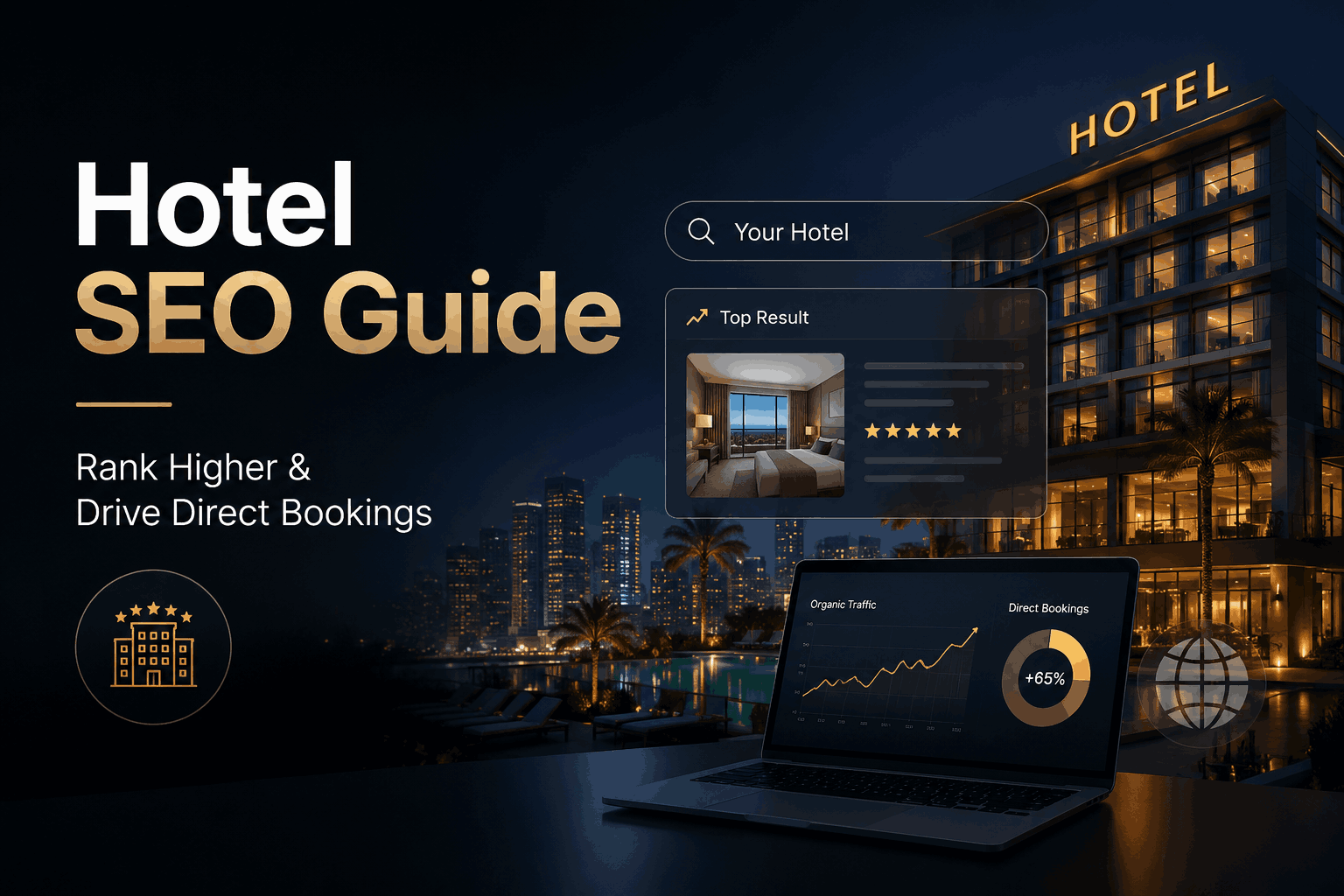
ByHotel SEO gets your property found on Google before a guest reaches an OTA listing. It covers your website’s technical setup, your Google Business Profile, your content, and the links and citations that build trust with search engines. A hotel with strong SEO ranks for its own name, its city and neighborhood, and specific searches like “hotel near [landmark] with pool,” pulling in bookings that skip the OTA commission entirely.
I specialize in helping hospitality brands and local businesses strengthen their online presence through tailored SEO and GEO (Generative Engine Optimization) strategies. Designed as a comprehensive resource, this guide covers every essential aspect of hotel SEO—from resolving foundational technical issues and developing high-converting content to optimizing for visibility across modern, AI-powered search engines.
Core Components of Hotel SEO
1. Technical SEO makes sure Google can crawl, index, and rank your website correctly.

2. On-page SEO optimizes individual pages, room types, amenities, and location content, for specific searches.

3. Local SEO gets your property into the Map Pack and local search results.

4. Content SEO builds authority through guides, area information, and answers to traveler questions.

5. Link building and citations establish trust through mentions from other trusted sites.

6. GEO gets your hotel cited inside AI-generated travel answers, alongside traditional search results.
Technical SEO for Hotels
Fix page speed before anything else. A slow-loading site loses both rankings and bookings, since guests abandon a page that takes more than a few seconds to load, and Google factors speed directly into rankings.
Make sure your booking engine is crawlable. Some booking engines run entirely in JavaScript or load inside an iframe that Google cannot read properly, which hides room and rate information from search results.
Use a clean, logical URL structure. URLs like yoursite.com/rooms/deluxe-king give Google and users clearer information than long strings of parameters or IDs.
Fix duplicate content across room and rate pages. Many hotel sites generate near-identical pages for each rate plan on the same room, and this duplication confuses Google about which page to rank.
Submit an updated XML sitemap. Include every room type, amenity page, and location page, and resubmit it whenever you add new content, so Google finds new pages faster.
Secure your site with HTTPS. This is now a baseline requirement, since Google flags non-secure sites to users directly, and an insecure connection damages trust before a guest even sees your rates.
On-Page SEO for Hotel Websites
Write a unique title tag and meta description for every page. Room pages, amenity pages, and location pages each need their own targeted title, since duplicate or generic titles waste ranking opportunity across your site.
Target specific search terms per page, not the same broad terms everywhere. A page about your rooftop pool should target “hotel with rooftop pool in [city],” while your homepage targets your hotel name and general location terms.
Use descriptive, keyword-rich image alt text. Alt text describing “oceanview king room balcony” helps both search rankings and accessibility, and hotel searches often include an image search component.
Structure content with clear headings. Break amenity and room pages into scannable sections with H2 and H3 headings, since both users and search engines read structured pages more easily than long blocks of text.
Add FAQ content to key pages. Answering questions like “is parking included” or “what time is check-in” directly on relevant pages captures long-tail searches and supports rich results in Google.
Local SEO for Hotels
Complete every field in your Google Business Profile. Category, amenities, hours, photos, and attributes all feed into how Google ranks you for local and “near me” searches.
Add location-specific landing pages for nearby attractions. A page targeting “hotels near [airport]” or “hotels near [convention center]” captures searches an OTA’s generic city listing cannot match with the same specificity.
Keep your name, address, and phone number identical everywhere. Match this information exactly across your website, Google Business Profile, OTA listings, and travel directories, since mismatches weaken local ranking signals.
Get listed on travel-specific directories. Platforms like TripAdvisor, Booking.com, and regional tourism boards carry authority specific to hospitality, beyond general business directories.
Encourage and respond to reviews consistently. Review volume, recency, and your response rate all factor into local rankings, and guests read your responses as a sign of how the property treats concerns.
Also Read – Core Strategies to Increase Direct Bookings
Content SEO for Hotels
Publish area guides covering nearby attractions, restaurants, and transport. This content brings in travelers searching before they choose a hotel, and it positions your property as the local authority for the destination.
Write seasonal and event-based content. A guide to visiting during a local festival or peak travel season captures searches tied to specific dates, and this content can rank well ahead of the season each year.
Create dedicated pages for each room type and package. A generic “rooms” page performs worse than individual pages for each room category, since each targets a different, more specific search.
Keep content updated as amenities and policies change. Outdated information on parking, pet policies, or amenities damages trust with both search engines and guests, so review key pages at least twice a year.
Link Building and Citations for Hotels
Get listed accurately on every major travel directory. TripAdvisor, Google Business Profile, Booking.com, and regional tourism sites all serve as citations that reinforce your legitimacy and location.
Partner with local businesses and attractions for mentions. A nearby restaurant, tour operator, or event venue may link to your property in a recommended stay list, and this local relevance carries real ranking value.
Reach out to travel bloggers and local press. A feature or mention from a travel blog or local news site builds authority that a paid directory listing cannot replicate.
Avoid low-quality, irrelevant backlinks. Links from unrelated or spammy sites can hurt more than help, so prioritize quality and relevance over volume when building links.
GEO for Hotels: Ranking in AI Search
Write content AI models can extract as a direct answer. A short, clear paragraph stating your amenities, location, and nearby attractions gets cited more easily than long promotional copy.
Keep facts about your property consistent across every platform. AI tools cross-check your website against review sites and directories, so a mismatch in amenities or policies reduces the chance of a confident citation.
Answer common traveler questions directly on your site. Questions like “best hotel near [landmark] for families” or “hotels with free breakfast in [city]” mirror how travelers now query AI tools directly.
Test your visibility across AI platforms regularly. Ask ChatGPT, Gemini, and Perplexity common questions about hotels in your area, and track whether and how your property appears in the response.
Measuring Hotel SEO Performance
Track organic traffic and keyword rankings through Google Search Console. Watch impressions and clicks for your target terms, room types, and location pages over time.
Monitor your Google Business Profile insights. Calls, direction requests, and website clicks from your profile show whether local visibility is converting into real guest interest.
Track the direct-to-OTA booking ratio. A rising share of direct bookings is the clearest sign that SEO investment is translating into commission savings.
Check AI citation appearances periodically. Since no standard tool tracks this yet, manual testing across AI platforms remains the most reliable way to confirm visibility.
Frequently Asked Questions
How long does hotel SEO take to show results?
Technical and Google Business Profile fixes can show impact within a few weeks. Competitive keyword rankings and organic traffic growth typically take three to six months.
Do OTA listings help or hurt my own hotel SEO?
They can help. Strong OTA reviews and profiles build brand recognition and search volume for your hotel name, which supports your own website’s rankings, as long as your direct site stays competitive on content and pricing.
Should a hotel invest in SEO or paid ads first?
SEO delivers longer-term, lower-cost traffic, while paid ads deliver faster but ongoing-cost visibility. Most hotels benefit from running both together, with SEO reducing dependence on paid channels over time.
How many pages does a hotel website need for strong SEO?
There is no fixed number. A property with distinct room types, amenities, and nearby attractions typically needs one focused page per major topic, rather than cramming everything onto a single page.
Does hotel SEO differ from SEO for other local businesses?
The core principles match, technical setup, local optimization, and content, but hotel SEO adds booking engine considerations, OTA competition, and travel-specific directories that most local businesses do not deal with.
Get a Complete SEO and GEO Strategy for Your Hotel
You now have the full picture of what hotel SEO covers, from technical fixes to content to AI search visibility.
I offer complete SEO and GEO services, covering technical audits, on-page and local optimization, content strategy, and AI citation building. My work includes hands-on execution, not just a list of recommendations.
Contact me today. Share your website URL. I will send back a clear list of what is holding your hotel’s rankings back, and how to fix it.