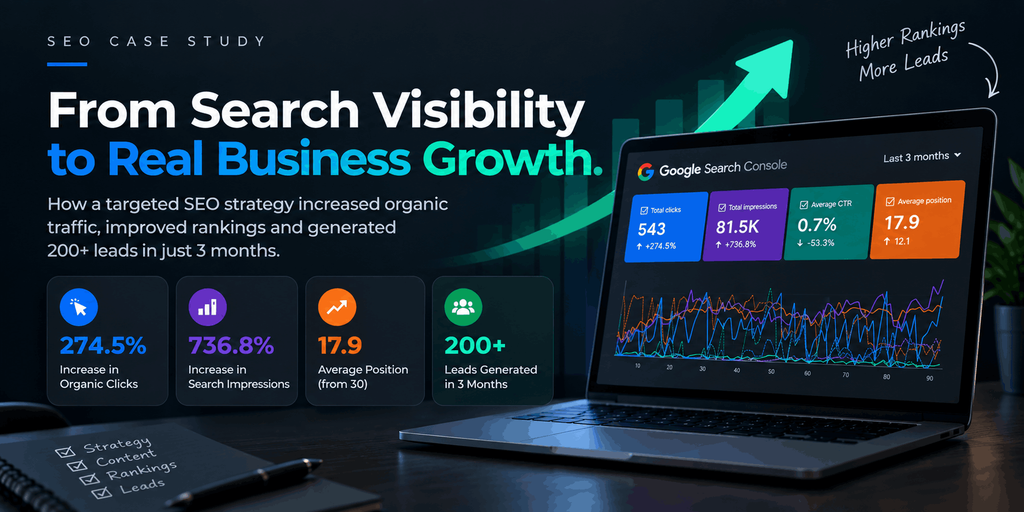
I worked on the SEO campaign for a reputation management business operating in a competitive market focused on review removal and online reputation management.
The primary objective was to increase organic visibility for commercially relevant searches, improve keyword rankings, strengthen topical authority, and ultimately generate more qualified enquiries through organic search.
Over the last three months, the campaign produced significant growth in Google Search Console data, with organic clicks increasing from 145 to 543 and impressions increasing from 9.74K to 81.5K. During the same period, the client generated more than 200 leads.
Key Results
| Metric | Previous 3 Months | Last 3 Months | Change |
|---|---|---|---|
| Organic Clicks | 145 | 543 | +274.5% |
| Impressions | 9.74K | 81.5K | +736.8% |
| Average CTR | 1.5% | 0.7% | -53.3% |
| Average Position | 30 | 17.9 | 12.1-position improvement |
| Leads | 50 | 200+ | Significant increase |
The Challenge
The website operated in a highly competitive and commercially focused search environment. Users searching for review removal services are generally looking for a solution to a specific reputation problem, which makes search intent particularly important.
The challenge was therefore not simply to increase traffic. The SEO strategy needed to improve visibility for searches related to review removal, negative reviews, specific review platforms, industry-specific problems, and users actively looking for professional assistance.
At the same time, the website needed stronger topical coverage so that search engines could better understand its expertise across the wider review management and reputation management space.
SEO Strategies I Used
1. Keyword Research and Search Intent
I focused the keyword strategy around both commercial and informational search intent. Instead of concentrating only on broad terms such as “review removal,” I identified more specific opportunities covering different platforms, industries, services and user problems.
This included searches related to Google review removal, negative review removal, review removal services, Glassdoor reviews, TripAdvisor reviews and industry-specific searches such as review removal services for dentists.
The objective was to build a wider keyword footprint while maintaining a strong connection between the search query and the services offered.
2. Building Topical Authority
A major part of the campaign was expanding the website’s topical coverage.
I developed and optimised content around the broader subject of online reviews, review removal and reputation management. This included articles addressing whether businesses can remove reviews, how different platforms handle review removal, legitimate reasons for removing reviews, and ways businesses can manage negative feedback.
Rather than treating each keyword as an isolated target, the content strategy connected related topics to establish stronger relevance around the overall subject.
3. NLP-Friendly Content Optimisation
I also worked extensively on making the website’s content more precise, structured and NLP-friendly.
Content was rewritten to answer search queries directly, use relevant terminology naturally, and provide clear explanations without unnecessary keyword repetition. Headings, paragraphs and supporting sections were structured around the actual questions users were searching for.
This approach helped create content that was easier for both users and search engines to understand while naturally covering related search terms and entities.
4. On-Page SEO
On-page optimisation was another important component of the campaign. I worked on improving page titles, meta descriptions, headings and content structure to better align individual pages with their target search intent.
Content was also reorganised where necessary so that important information appeared clearly and users could quickly understand the answer to their query.
The aim was to make each important page more relevant to its target topic rather than relying on keyword insertion alone.
5. Search-Driven Content Creation
The content strategy was based on identifiable search opportunities rather than simply publishing articles for the sake of increasing content volume.
I focused on topics that addressed real questions and problems faced by businesses dealing with negative or unfair reviews. This included platform-specific topics, review removal processes, reputation management questions and searches related to getting more positive reviews.
This allowed the website to target users at different stages of the search journey, from those researching a problem to those actively considering a professional service.
6. Commercial and Comparison Content
I also targeted users further along the buying journey through commercial and comparison-focused content.
This included comparisons between reputation management solutions and articles examining different approaches to dealing with negative reviews. These searches are valuable because users conducting comparisons are often evaluating potential solutions rather than simply looking for general information.
7. Long-Tail Keyword Expansion
Another focus was identifying more specific, lower-volume searches with clear intent.
For example, a search such as “Google review removal service for dentist” provides much more context about the user’s problem than a broad search for “review removal.”
I incorporated similar variations based on platform, industry, service type and user intent. This helped expand the number of relevant searches for which the website could appear.
8. Continuous Content Refinement
SEO work was treated as an ongoing optimisation process rather than a one-time content exercise. Existing pages were reviewed and refined to improve their relevance, readability, structure, keyword coverage and alignment with search intent.
This allowed the campaign to improve existing assets while simultaneously expanding the site’s coverage through new content.
Google Search Console Performance
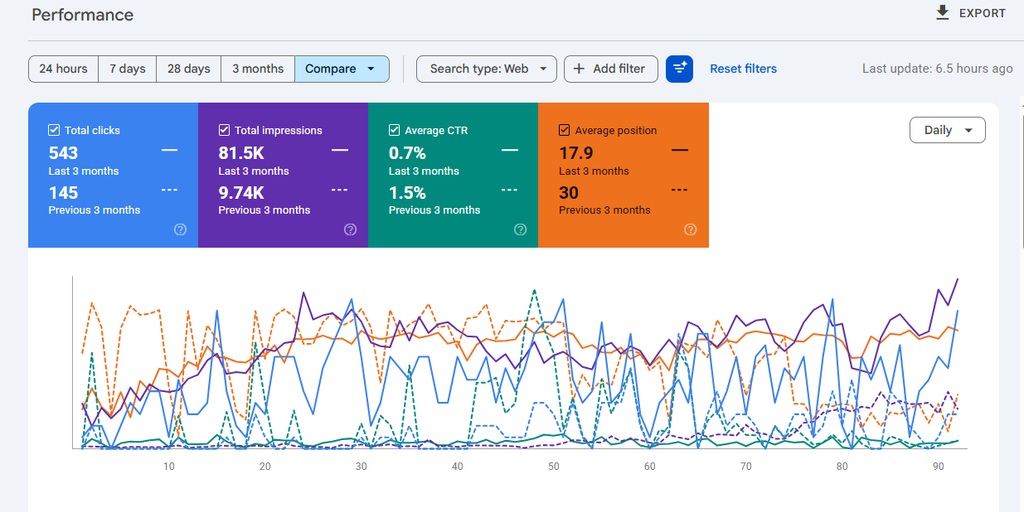
The Google Search Console data shows a substantial improvement in organic search performance over the three-month comparison period.
Organic Clicks Increased by 274.5%
Organic clicks increased from 145 in the previous three months to 543 in the last three months.
That represents an increase of 398 clicks, or approximately 274.5% growth.
The website therefore generated almost four times as many organic clicks compared with the previous three-month period.
Impressions Increased by 736.8%
Search impressions experienced even stronger growth, increasing from 9.74K to 81.5K.
This represents an increase of approximately 71,760 impressions, or 736.8% growth.
The increase indicates that Google began displaying the website for a significantly larger range of searches.
This expansion in visibility is particularly important because it shows that the SEO campaign was increasing the website’s overall presence in Google’s search results, rather than simply improving performance for a handful of existing keywords.
Average Position Improved from 30 to 17.9
The average position improved from 30 to 17.9, representing a 12.1-position improvement.
Moving from an average position around page three toward page two and, for many individual queries, closer to the first page gives the website substantially more opportunities to receive organic traffic.
As more keywords move toward stronger positions, the potential for clicks and enquiries increases.
Understanding the CTR Decline
The average CTR decreased from 1.5% to 0.7% during the same period.
Although this appears negative in isolation, it needs to be considered alongside the significant increase in impressions.
When a website’s organic visibility expands rapidly, it can begin appearing for many new queries where it ranks lower or where the search intent is broader. These additional impressions can reduce the overall average CTR even while the total number of clicks increases substantially.
That is exactly what happened here. Despite the CTR declining, organic clicks increased from 145 to 543, while impressions increased from 9.74K to 81.5K.
Therefore, the more meaningful indicators of growth are the substantial increase in total search exposure, organic clicks and ranking performance.
Lead Generation
The most important outcome was not simply the increase in rankings or impressions. The campaign also contributed to business growth.
During the last three months, the client generated more than 200 leads.
This demonstrates that the increased organic visibility was reaching users who were taking meaningful actions and entering the sales pipeline.
For a service-based business, this is ultimately more valuable than traffic alone. The objective of the SEO campaign was to create visibility that could translate into genuine commercial opportunities, and the 200+ leads generated during the period demonstrate the business impact of that approach.
Overall Results
The campaign produced strong improvements across the main organic search metrics:
| Result | Outcome |
|---|---|
| Organic clicks | 543 |
| Organic click growth | 274.5% |
| Search impressions | 81.5K |
| Impression growth | 736.8% |
| Average position | 17.9 |
| Position improvement | 12.1 positions |
| Leads generated | 200+ |
Ready to Grow Your Organic Leads?
This case study shows how a focused SEO strategy can increase search visibility, improve rankings, and generate measurable business results. If you want to turn organic search into a consistent source of qualified leads, I can help build and execute an SEO strategy tailored to your business.
Want to achieve similar SEO growth? Let’s talk about your goals and identify the opportunities that can drive more traffic, rankings, and leads.