 By
ByYour competitor’s page loads slower than yours. Their content reads worse than yours. Yet ChatGPT recommends them, and Google shows their answer box, not yours.
I am Prabir Mandal, an SEO and GEO (Generative Engine Optimization) specialist. I track traffic loss, lead loss, and revenue loss for businesses that delay search optimisation.
This article lists the real costs of ignoring SEO and GEO, backed by research data. No guesswork. Just the numbers, the sources, and what each cost means for your business.
Search behaviour changed faster between 2024 and 2026 than in the previous decade combined. Businesses that measure only “traffic” now miss most of the cost, because most searches never produce a click at all.
Cost 1: You Lose Traffic That Never Reaches Your Site
Most searches today end without a click. SparkToro’s 2026 study, based on Similarweb clickstream data, found that 68.01% of Google searches in the US ended without any click between January and April 2026. That figure sat near 50% just seven years earlier.
The number gets worse when Google shows an AI Overview. The same research found that AI Overviews now appear on more than 20% of searches, and click-through rates drop by close to 60% when they appear.
Ignoring SEO does not just mean a lower ranking. It means your business competes for a shrinking pool of clicks, while a growing share of searches get answered without ever sending a visitor to any website.
Cost 2: You Disappear from AI-Generated Answers
Zero-click behaviour reaches its highest point inside AI-native surfaces. Seer Interactive’s study of 25.1 million impressions found that Google’s AI Mode produces a 93% zero-click rate, compared to a lower rate for standard AI Overviews.
Pew Research measured a related pattern from the user side. Its July 2025 study found that users click a link inside an AI Overview in only about 1% of cases. The answer satisfies the user before they reach any website.
This changes the real goal of search optimisation. A page can rank well and still generate almost no traffic, if the AI model answers the question without citing a source that gets clicked. The business that gets named inside the answer keeps its brand in front of the buyer. The business left out does not.
Cost 3: You Pay More for Ads to Replace Lost Organic Reach
Many businesses respond to falling organic visibility by increasing ad spend. This fix works only while the budget lasts.
Growthfolks’ 2025 analysis of SEO economics found that organic search leads convert at 14.6%, compared to 10% for paid search leads. Paid traffic also stops the moment a business stops paying, while a well-ranked page continues to generate visits without an ongoing cost per click.
A business that ignores SEO does not remove this cost. It shifts the cost into a permanent, recurring ad budget, one that must grow every year just to hold the same position.
Cost 4: You Lose the Return SEO Would Have Delivered
SEO carries a measurable return once it works. Savo Group’s 2026 research found a median return on SEO investment of 748%, or roughly $22 back for every $1 spent.
Ignoring SEO does not avoid a cost. It forfeits this return and leaves that budget with paid channels that convert at a lower rate and stop producing results the moment spending pauses.
Cost 5: Most of Your Content Produces Zero Return
A large share of published content never earns any organic traffic at all. StackedReview’s 2026 industry data found that 96.55% of content on the internet receives zero traffic from Google, largely because it targets the wrong keywords or lacks the depth AI models and search engines now reward.
This cost hides inside a marketing budget. A business pays a writer, publishes a page, and never checks whether the page targets a real, searched question. The money spent on that page produces no return, while a competitor’s page, built around real search and AI-query data, keeps generating visits and citations for years.
Cost 6: You Lose Local Customers to Competitors with Complete Profiles
Local search carries some of the highest buying intent of any search category. Go Fish Digital’s 2026 research on local SEO found that businesses with complete, optimised location pages saw the large majority of their signup traffic come directly from those pages, which shows how strongly local signals drive both visibility and conversions. Read the full local SEO study here.
A business with outdated hours, a missing address, or no recent reviews on its Google Business Profile loses these searches to a competitor with a complete, current profile. This loss happens before any phone call or website visit, so most business owners never see it on a report.
Cost 7: Recovery Takes Far Longer Than Prevention
Search visibility, once lost, does not return quickly. A large third-party study of 892 domain migrations found an average recovery time of 523 days, and 17% of sites in the study never recovered their prior traffic level.
This same pattern applies to businesses that ignore SEO for years, then attempt to fix it after a competitor already holds the top positions and the AI citations. Prevention costs a fraction of what recovery costs, in both time and budget.
What These Costs Add Up To
| Area | What Ignoring SEO/GEO Costs You | Source |
|---|---|---|
| Traffic | Up to 68% of searches produce no click at all | SparkToro, 2026 |
| AI visibility | Only ~1% of AI Overview readers click a source link | Pew Research, 2025 |
| Ad spend | Paid leads convert at 10%, versus 14.6% for organic | Growthfolks, 2025 |
| ROI | Median SEO return is 748%, or $22 per $1 spent | Savo Group, 2026 |
| Content spend | 96.55% of published content earns zero traffic | StackedReview, 2026 |
| Local leads | Complete local profiles capture the majority of high-intent signups | Go Fish Digital, 2026 |
| Recovery time | Average 523 days to recover lost visibility, 17% never recover | Digital Applied, 2026 |
How This Connects to E-E-A-T
Google’s E-E-A-T framework rewards the same signals that AI models use to decide which sources to cite. Ignoring SEO and GEO weakens all four signals at once.
Experience drops when your content stays generic and never reflects real client work or first-hand results.
Expertise drops when pages carry no author name, no credentials, and no depth beyond surface-level advice.
Authoritativeness drops when no other site links to or mentions your business, leaving AI models with no outside proof to check your claims against.
Trustworthiness drops when your Google Business Profile, reviews, and contact details go outdated, which signals unreliability to both users and algorithms.
A business that builds these four signals protects itself against all seven costs listed above, because Google’s ranking systems and AI citation systems reward the same underlying proof of quality.
A Quick Cost Check for Your Business
Answer these five questions honestly.
- Has your organic traffic dropped in the last twelve months, without a clear explanation?
- Does your ad budget keep rising just to hold the same lead volume?
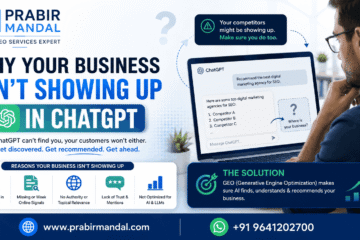
- Have you checked whether ChatGPT or Gemini names your business for a relevant question?
- Is your Google Business Profile fully updated, with current hours and recent reviews?
- Do most of your published pages actually rank for a real, searched keyword?
A “no” or “not sure” answer on any question points to a hidden cost already affecting your business today.
Stop the Hidden Cost Before It Compounds
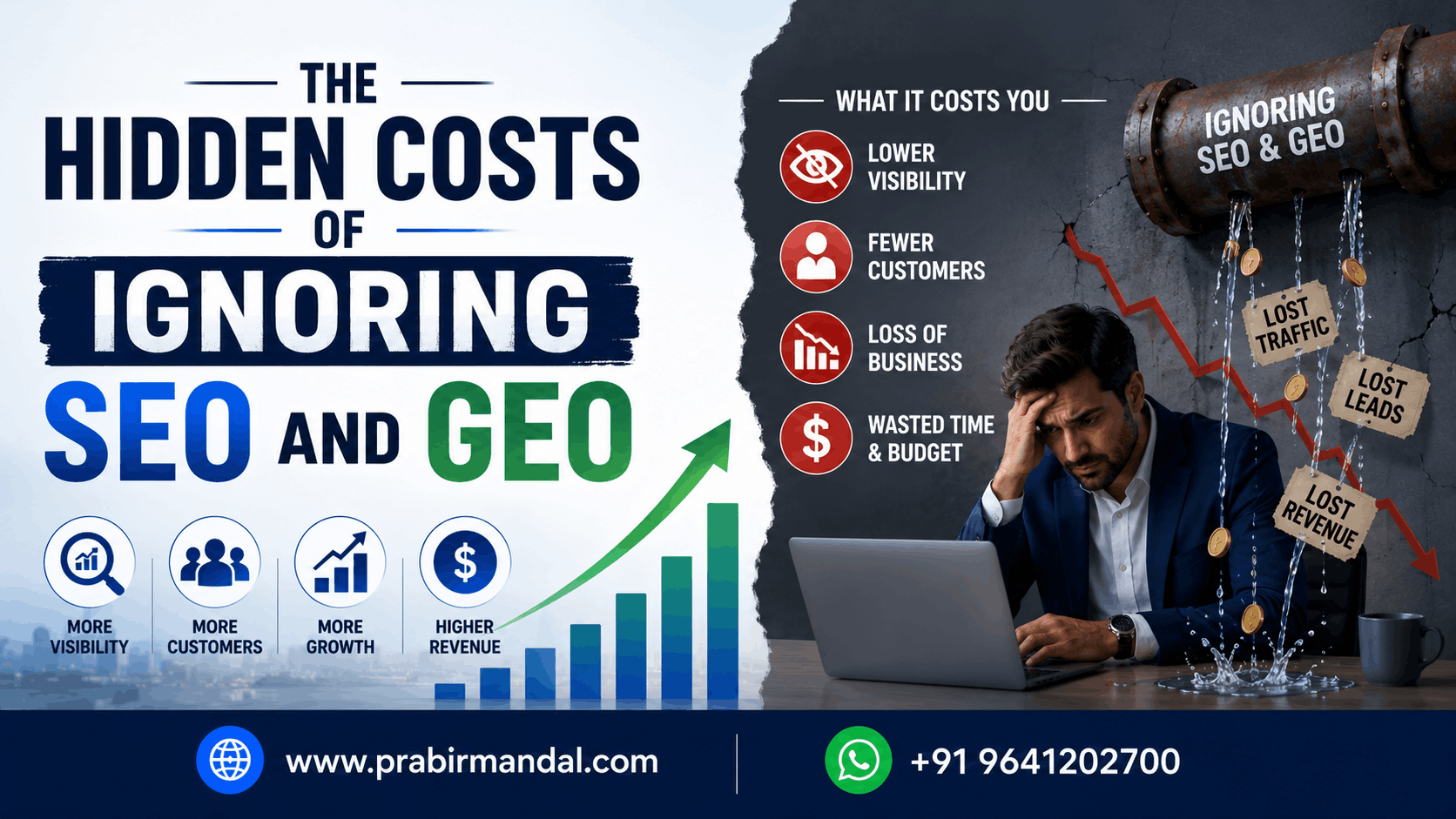
Every month without SEO and GEO adds another 523-day recovery clock, another AI answer that names a competitor instead of you, and another ad dollar spent to replace traffic you could have earned for free.
I run full SEO and GEO audits that show you exactly where these costs sit in your business, then build the fix: technical SEO and content strategy, plus GEO strategy for AI search visibility.
Contact me today. Send me your website. I will show you the hidden costs in your current search performance, and the fastest path to close them.