 By
ByYou ask ChatGPT a question about your industry. It names three competitors. It does not name you.
I am Prabir Mandal, an SEO and GEO (Generative Engine Optimization) specialist. I help businesses appear in ChatGPT, Google Gemini, Google AI Overviews, and Perplexity.
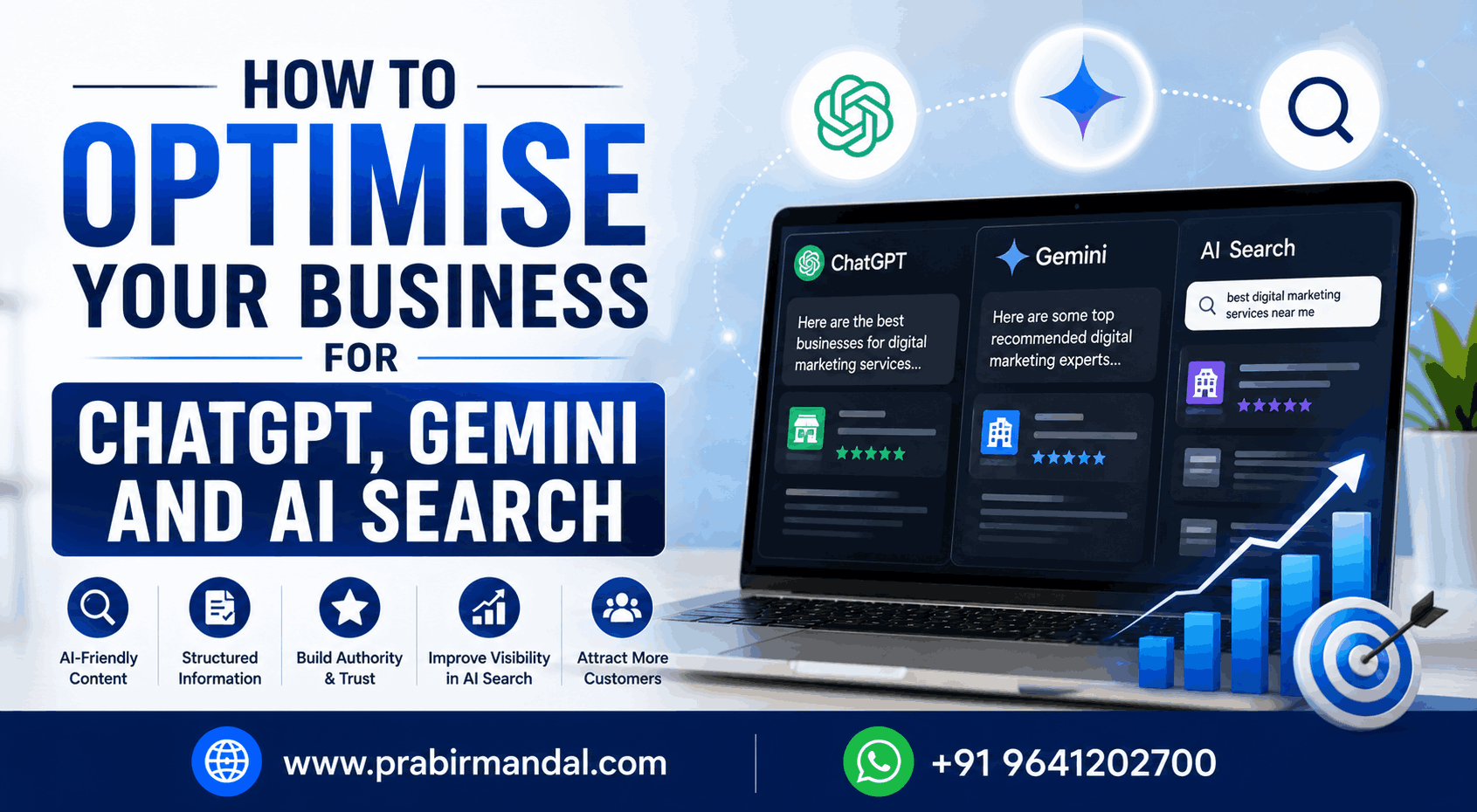
Here, I am giving you step-by-step process to optimise your business for AI search. No theory. No filler. Just the exact actions that build AI visibility.
AI models cite businesses that state clear facts, use structured markup, and appear across multiple independent sources. This article shows you how to build all three, in order.
What AI Search Actually Means
AI search covers any tool that answers a question directly, instead of showing ten blue links. This includes ChatGPT, Google Gemini, Google AI Overviews, Perplexity, and Microsoft Copilot.
These tools work differently from classic Google search. Google search ranks pages. AI search picks facts from pages and rewrites them into one direct answer.
This changes your goal. Classic SEO asks: “How do I rank on page one?” AI search optimisation asks: “How do I become the source the AI model quotes?”
Why Your Business Might Be Missing from AI Answers
Three problems keep most businesses out of AI answers.
First, your content buries facts inside marketing language. AI models pull short, direct statements. A paragraph full of adjectives gives the model nothing to quote.
Second, your website lacks structured data. Schema markup tells a search engine or AI model exactly what a page contains. Without it, the model has to guess, and models skip pages that require guessing.
Third, your business has no proof outside your own website. AI models check facts across multiple sources. A business that only exists on its own site looks unverified.
Fix these three problems, and you fix most of your AI visibility gap.
Step 1: Rewrite Your Content into Direct, Quotable Facts
AI models copy short, factual sentences. Give them sentences they can lift directly into an answer.
Compare these two examples:
- Weak: “We help businesses reach their full potential through innovative digital strategies.”
- Strong: “We provide SEO, paid ads, and GEO services for e-commerce brands in the UK and US.”
The second sentence names the service, the audience, and the location. An AI model can quote it word for word. The first sentence gives the model nothing to use.
Apply this rule to your homepage, service pages, and About page. State what you do, who you serve, and where you operate, in the first two sentences of each page.
Step 2: Answer the Exact Questions Your Customers Ask AI Models
People type direct questions into ChatGPT and Gemini, such as “best CRM for a small clinic” or “top digital marketing agency in Toronto.”
Most business websites describe services in general terms. Few websites answer the exact question a customer types into an AI chat tool.
Build a list of real questions your customers ask. Use your sales calls, support tickets, and Google’s “People Also Ask” boxes as sources. Then write a direct answer to each question, in one or two sentences, before you add supporting detail.
Place these Q&A blocks on your service pages and in a dedicated FAQ section. This format matches how AI models search for answers, which raises your chance of getting cited.
Step 3: Add Schema Markup Across Your Site
Schema markup is code that labels your content for machines. It tells an AI model your business name, service list, location, pricing, and reviews, without forcing the model to interpret plain text.
Add these schema types first:
- Organization schema, for your business name, logo, and contact details.
- Service schema, for each service you offer.
- FAQ schema, for your question-and-answer sections.
- Review schema, for client testimonials and star ratings.
A site with correct schema markup gives an AI model verified facts instead of guesses. This single change often produces the fastest visibility gain.
Step 4: Build Proof Beyond Your Own Website
AI models trust claims that show up in more than one place. A business mentioned only on its own site looks unproven, no matter how well the site reads.
Build outside mentions through these channels:
- Industry directories, relevant to your sector and location.
- Reddit and Quora, by answering real questions in your field.
- Google Business Profile, with active review collection.
- Guest posts and expert quotes, on industry sites and news outlets.
- Wikipedia and Wikidata, where your business meets notability standards.
Each mention acts as a vote of confidence. AI models weigh these votes when they decide which business to cite.
Step 5: Publish and Update Content on a Schedule
AI models favour sources that show recent activity. A page last updated three years ago signals lower relevance than a page updated last month.
Set a content schedule. Update your service pages twice a year. Publish a new blog post or resource monthly. Add new data, examples, or sections to existing pages instead of only creating new ones.
Consistent updates tell an AI model your business stays active and current, which supports repeat citations over time.
ChatGPT vs Gemini vs Google AI Overviews: Key Differences
| Factor | ChatGPT | Google Gemini | Google AI Overviews |
|---|---|---|---|
| Primary data source | Training data plus live browsing | Google’s search index and Knowledge Graph | Google’s search index |
| Structured data weight | Moderate | High | High |
| Update frequency | Periodic, plus real-time browsing | Near real-time | Near real-time |
| Best content format | Direct facts, FAQ blocks | Schema-marked pages, entity clarity | Concise, direct answers near the top of the page |
| Outside mentions | Strong factor | Strong factor, tied to Google’s index | Strong factor |
Each tool weighs these signals differently, but all three reward the same base work: clear facts, structured data, and outside proof.
How This Connects to E-E-A-T
Google’s E-E-A-T framework stands for Experience, Expertise, Authoritativeness, and Trustworthiness. AI models apply a similar filter, even outside Google’s own tools.
Experience shows through first-hand detail, like case studies, screenshots, and specific results.
Expertise shows through author credentials and content depth. Name the person who wrote the page. State their background in one sentence.
Authoritativeness shows through outside mentions, backlinks, and citations from other trusted sites.
Trustworthiness shows through accurate contact details, clear pricing where possible, verified reviews, and a secure, well-maintained website.
Build these four signals into every page, and you improve both your Google ranking and your AI citation rate at the same time.
A Quick AI Visibility Self-Check
Answer these five questions about your website.
- Does your homepage state your service in one direct sentence?
- Does your website carry Organization, Service, and FAQ schema?
- Can someone find your business mentioned outside your own website?
- Does any page answer a specific question your customer would type into ChatGPT or Gemini?
- Was your website content updated in the last six months?
A “no” answer to any question marks a gap in your AI visibility. Close that gap before you move to the next step.
Frequently Asked Questions
What is the difference between SEO and GEO?
SEO optimises a website to rank in classic search results. GEO optimises content so AI models like ChatGPT and Gemini can find, understand, and cite it directly. The two overlap but require different content formats.
Does Google ranking guarantee I show up in AI Overviews?
No. A page can rank on page one of Google and still get skipped by AI Overviews if it lacks clear facts or structured data. AI Overviews pulls from the page content directly, not just the ranking position.
How long does AI search optimisation take to show results?
Most businesses see early visibility changes within two to three months, once schema markup goes live and outside mentions start building. Full results depend on your industry, competition, and how often the AI model updates its index.
Do I need to rebuild my website for AI search?
No. Most businesses fix this by editing existing content, adding schema markup, and building outside mentions. A full rebuild is rarely necessary.
Which AI model should I optimise for first?
Start with the model your customers use most. B2C businesses often see faster ChatGPT and Google AI Overviews adoption. B2B and technical industries often see stronger Gemini and Perplexity usage. Track your referral data to confirm.
Get Your Business Cited by AI Search
You now have a five-step process: direct facts, question-based content, schema markup, outside proof, and a content schedule. Each step builds on the last one.
Most business owners know this work matters but lack the time to execute it across every page, plus track results month over month.
I build GEO strategies for businesses that want to appear in ChatGPT, Google Gemini, and AI Overviews. My process includes a full AI visibility audit, fact-based content rewrites, complete schema markup setup, an outside-mention building plan, and monthly citation tracking.
Contact me today. Tell me your business name and industry. I will show you exactly where your AI visibility gaps sit, and the fastest way to close them.