 By
ByMost small business owners spend money on marketing every month. Few of them have a written marketing strategy. This gap costs money, time, and growth.
I am Prabir Mandal, an SEO and GEO specialist. I work with small businesses, e-commerce brands, and agencies across the UK, US, Australia, and Canada. I have watched businesses waste ad budgets because they had tactics but no strategy. This article explains why a marketing strategy matters, what happens without one, and how to build one that works.
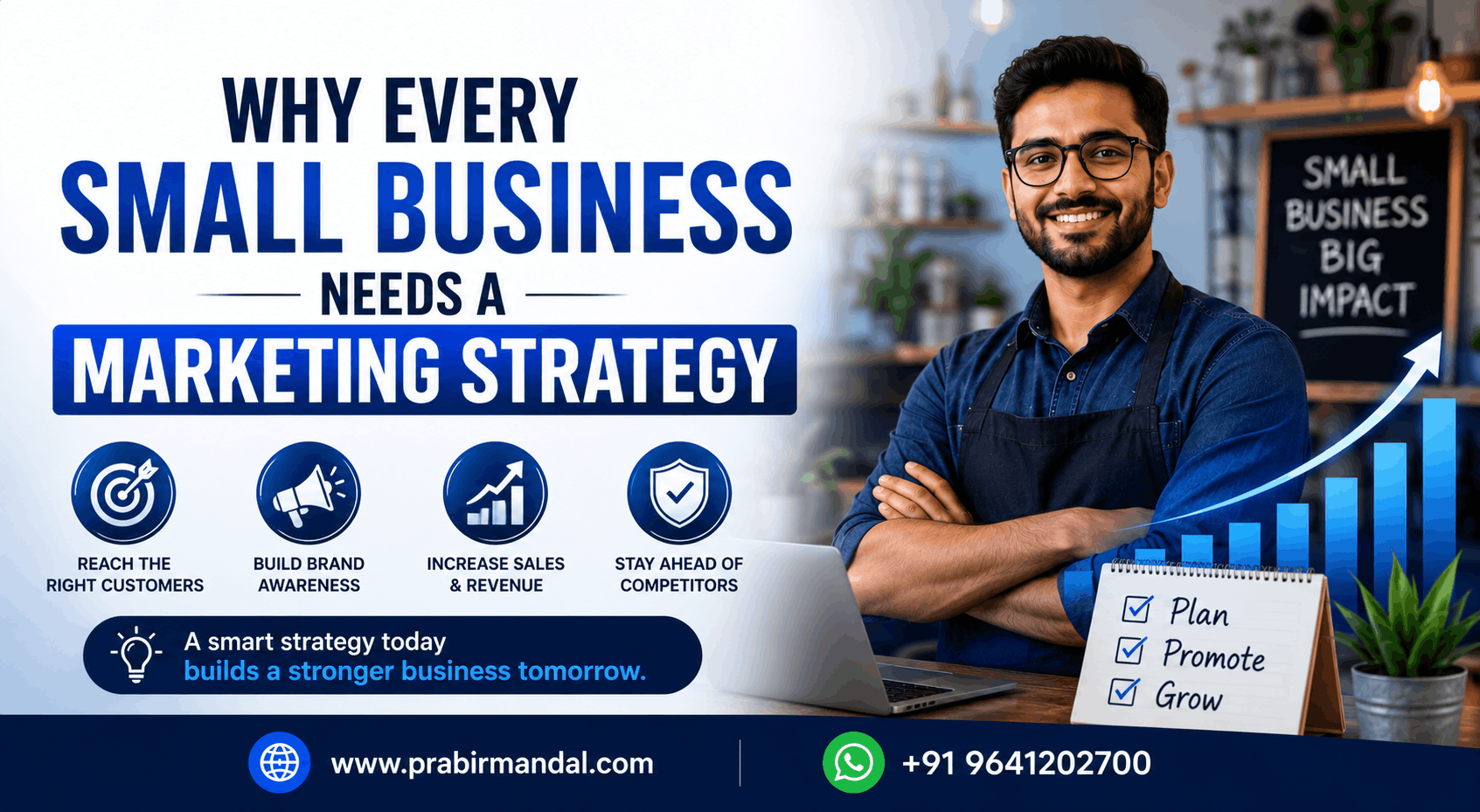
A marketing strategy turns scattered effort into measurable growth. It gives small businesses a clear path instead of guesswork. SEO and GEO now form a core part of that path, since customers search across both traditional engines and AI platforms. Businesses that build a strategy today gain ground on competitors who still operate without one.
What Is a Marketing Strategy?
A marketing strategy is a written plan. It defines your target customer. It defines your goals. It defines how you will reach those goals with the budget you have.
A tactic is different from a strategy. Posting on Instagram is a tactic. Running Google Ads is a tactic. A strategy decides which tactics you use, why you use them, and how you measure results.
Small businesses often skip this step. They jump straight into tactics. They post content without a plan. They run ads without clear targeting. The result is wasted spend and inconsistent growth.
Why Small Businesses Skip Strategy
Small business owners wear many hats. They handle sales, operations, hiring, and finance. Marketing often becomes an afterthought.
Three reasons explain why strategy gets skipped:
Owners think strategy takes too much time. They want quick results, so they jump to execution.
Owners think strategy is only for big companies with big budgets. This is false. A strategy actually protects a small budget from waste.
Owners confuse activity with progress. Posting daily on social media feels productive. Without a goal behind it, this activity rarely converts into sales.
The Real Cost of Not Having a Strategy
I have reviewed Google Search Console data for multiple clients. The pattern is consistent. Businesses without a strategy show random traffic spikes and drops. Businesses with a strategy show steady, compounding growth.
Here is what happens without a strategy:
Budget gets spread across every platform instead of the platforms that matter. A local bakery does not need a Twitter strategy. It needs Google Business Profile optimization and local SEO.
Messaging changes every month. Customers see inconsistent branding, which reduces trust.
Marketing decisions get made on gut feeling, not data. A campaign gets killed too early or kept too long, based on emotion rather than numbers.
Growth stays flat even when spending increases. Money goes into channels that do not match the target customer.
Core Elements of an Effective Marketing Strategy
A working marketing strategy contains five parts. Each part answers a specific question.
Target audience. Who buys your product? What problem do they have? Where do they search for solutions?
Positioning. Why should a customer choose you over a competitor? What makes your offer different?
Channels. Which platforms reach your audience? This could be SEO, paid ads, email, or local search. Not every channel fits every business.
Budget allocation. How much money goes to each channel? This decision should follow data, not guesswork.
Measurement. How do you track results? Clicks, leads, and sales all need clear tracking so you know what works.
SEO as a Core Part of Small Business Strategy
Search engine optimization deserves a direct mention here, since it is my area of work. Most small businesses rely on local search. A customer searches “plumber near me” or “best bakery in [city].” If your website does not rank, that customer goes to a competitor.
SEO builds long-term visibility. Paid ads stop working the moment you stop paying. SEO keeps working after the initial setup, because it builds authority that search engines trust over time.
I worked with a client where organic clicks grew from 22.6K to 28K in three months, and impressions grew from 1.72M to 2.17M over the same period. The average ranking position also improved from 10.2 to 9.8. This growth came from a strategy, not a single tactic. It included technical fixes, content updates, and consistent tracking.
GEO: The New Layer of Marketing Strategy
Search behavior is changing. Customers now ask ChatGPT, Google Gemini, and Perplexity AI for recommendations, not just Google. This is where GEO, or Generative Engine Optimization, comes in.
If your business does not appear in AI-generated answers, you lose visibility to competitors who do. GEO requires structured content, clear entity signals, and consistent information across your website and other platforms. A modern marketing strategy accounts for this shift instead of ignoring it.
Marketing Strategy vs No Strategy: A Direct Comparison
| Factor | With a Marketing Strategy | Without a Marketing Strategy |
|---|---|---|
| Budget use | Spent on channels matched to the audience | Spread thin across every platform |
| Messaging | Consistent across all channels | Changes frequently, confuses customers |
| Growth | Steady and measurable | Random spikes and drops |
| Decision-making | Based on data and goals | Based on guesswork and trends |
| Long-term visibility | Builds through SEO and GEO | Depends only on paid ads |
| Team focus | Clear priorities each month | Constant switching between tactics |
How to Build a Marketing Strategy in Four Steps
Step 1: Define your customer. Write down their age, location, problem, and buying behavior. Be specific.
Step 2: Set one primary goal. Choose leads, sales, or brand awareness. Trying to achieve all three at once dilutes results.
Step 3: Pick two or three channels. Match channels to where your customer already searches or spends time. A B2B service business benefits more from SEO and LinkedIn than from Instagram Reels.
Step 4: Track and adjust monthly. Review what worked. Cut what did not. Increase budget on the channel showing the best return.
FAQs
Does a small business really need a formal marketing strategy?
Yes. A strategy prevents wasted spend and gives every marketing action a clear purpose. Businesses without one often see inconsistent results despite spending money regularly.
How much should a small business spend on marketing?
This depends on industry and goals. A common starting point is 5% to 10% of revenue, adjusted based on growth targets and competition.
Is SEO better than paid ads for small businesses?
Both serve different purposes. Paid ads bring fast, short-term traffic. SEO builds traffic that compounds over months and continues after ad spend stops. A strategy often uses both together.
What is GEO, and does my small business need it?
GEO stands for Generative Engine Optimization. It improves visibility in AI tools like ChatGPT and Gemini. Any business that wants to stay visible as search shifts toward AI answers should include GEO in its strategy.
How often should a marketing strategy be reviewed?
Review it monthly for performance and every three to six months for overall direction. Markets and customer behavior shift, and the strategy should reflect that.
Ready to Build a Strategy That Works?
I help small businesses and e-commerce brands build marketing strategies grounded in data, covering SEO, GEO, and paid ads. If you want a plan built around your business instead of generic advice, get in touch with me here and let’s talk about your growth.