 By
BySEO gets your law firm found in Google search results. GEO gets your law firm mentioned directly inside AI-generated answers, on tools like ChatGPT, Google Gemini, and Perplexity AI. Both matter, and neither replaces the other. A law firm that only focuses on one is leaving real client volume on the table.
I have worked with many law firms on search rankings, content strategy, and AI citation, including immigration and commercial practices.
Here I am breaking down exactly how SEO and GEO differ, and how a law firm should approach both.
SEO vs GEO for Law Firms – Core Differences
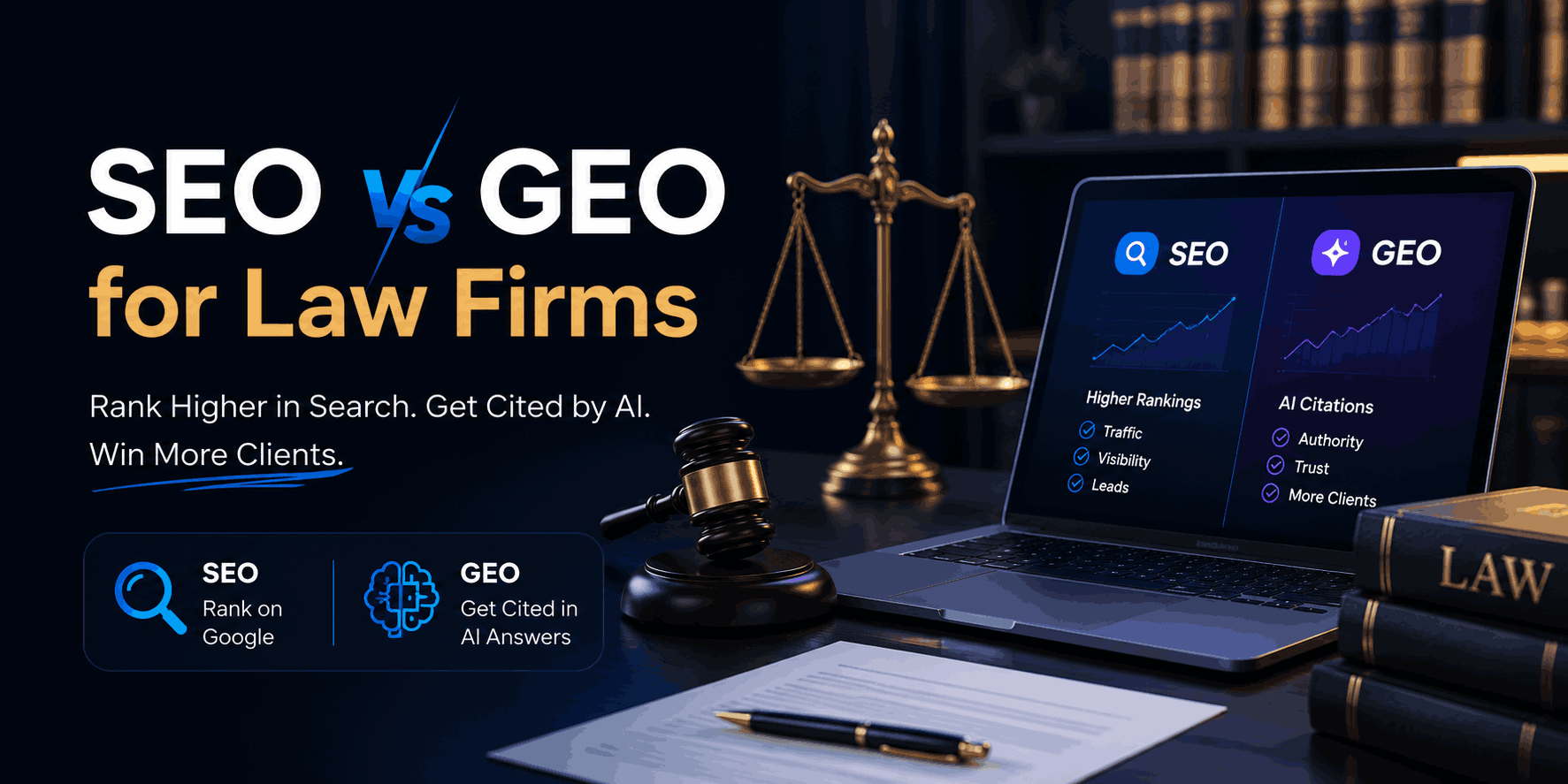
1. SEO ranks a page in Google's list of search results. GEO gets your content cited inside an AI-generated answer.

2. SEO relies heavily on backlinks and page authority. GEO relies more on content clarity and factual accuracy.

3. SEO results are measurable through rankings and traffic. GEO results are harder to track, since AI answers vary by query and platform.

4. SEO has existed and been refined for over two decades. GEO is newer, and best practices are still developing.

5. Both reward clear, well-structured, and genuinely useful content.
What SEO Does for a Law Firm
SEO places your website in front of people actively searching Google. A potential client types “divorce lawyer near me” or “how to file for a spouse visa,” and SEO determines whether your firm appears on that results page.
Ranking depends on authority, relevance, and technical health. Backlinks from other trusted sites, well-optimised practice area pages, and a fast, error-free website all combine to move your firm up the rankings.
SEO results are trackable through clear metrics. Tools like Google Search Console show exact rankings, click-through rates, and traffic by search term, giving you a clear view of what is working.
What GEO Does for a Law Firm
GEO places your firm’s information inside an AI tool’s direct answer. When a potential client asks ChatGPT “who is a good immigration lawyer in London,” GEO determines whether your firm gets mentioned in that response.
AI tools favor content they can extract with confidence. A clear, standalone paragraph answering a specific question gets cited far more often than a page full of vague, promotional language.
GEO depends heavily on consistency and verifiable detail. Your firm’s name, practice areas, and contact details need to match across your website, directories, and review platforms, since AI tools cross-check sources before citing them.
GEO results are harder to measure directly. There is no equivalent to Google Search Console for AI citations yet, so tracking relies on manually testing common client questions across different AI tools.
Where SEO and GEO Overlap
Both reward clear, specific practice area content. A page that directly answers what a service involves, what it costs, and how long it takes performs well for Google rankings and for AI citation, since both systems look for genuine, specific information.
Both depend on your firm being easy to verify. Consistent business details, visible credentials, and real client reviews build trust with search engines, AI tools, and human visitors at the same time.
Both benefit from structured data. Schema markup like LegalService and FAQ schema helps Google display rich results, and helps AI tools confirm facts about your firm quickly and accurately.
Where SEO and GEO Diverge
SEO still depends heavily on backlinks. GEO depends more on being directly quotable. A page can rank well in Google through strong link authority alone, even with average content. That same page needs genuinely clear, specific writing to get pulled into an AI answer, since link authority carries less weight in GEO.
SEO rewards long-form, comprehensive pages. GEO rewards short, direct, standalone answers. A 2,000-word practice area page can rank well in Google. AI tools often extract just one tight paragraph from that page, so the paragraph itself needs to work as a complete, accurate answer on its own.
SEO has established tools and reporting. GEO does not, yet. Rank tracking, backlink analysis, and traffic reporting are mature for SEO. GEO tracking still relies mostly on manual testing across different AI platforms.
Should a Law Firm Prioritise SEO or GEO?
Start with SEO if your firm has little to no search visibility today. Google search still drives far more direct traffic than AI tools for most law firms, so foundational SEO work usually delivers faster, more measurable results first.
Add GEO once your core content and technical SEO are solid. GEO builds on the same clear, specific content that strong SEO already requires, so the two efforts reinforce each other rather than compete for separate work.
Treat GEO as a growing, not optional, part of client research. More potential clients now start their research with an AI tool instead of a direct Google search. A firm ignoring GEO today risks losing this share of enquiries as the behavior grows.
Frequently Asked Questions
Does GEO replace the need for traditional SEO?
No. Google search still sends the largest share of traffic to most law firm websites. GEO adds a new channel; it does not replace the existing one.
Can a law firm do GEO without first doing SEO?
Not effectively. GEO relies on the same clear, well-structured, and technically sound content that SEO requires. Weak foundational content performs poorly in both systems.
How do I know if my law firm is being mentioned by ChatGPT?
Ask common client questions directly, such as “who is a good [practice area] lawyer in [your city],” across several AI tools, and check whether your firm appears. Repeat this regularly, since AI answers change over time.
Is GEO more important for certain practice areas?
Practice areas with high-volume, question-based research, such as immigration, family law, and personal injury, tend to see more AI-tool research activity, making GEO especially relevant there.
How long does GEO work take to show results?
Structural fixes, such as schema and consistency corrections, can show impact within weeks. Building broader citation presence across directories and trusted sources typically takes a few months.
Get a Combined SEO and GEO Strategy for Your Firm
You now know exactly how SEO and GEO differ, where they overlap, and how to prioritise both for your law firm.
I offer complete SEO and GEO services for law firms, covering search rankings, content strategy, schema, and AI citation building. My work includes hands-on fixes, not just a list of recommendations.
Contact me today. Share your website URL. I will send back a clear list of what is holding your visibility back, in Google and in AI search, and how to fix it.